Risk management is one of the seven quality indicators within NDIS Practice Standard 2. Auditors do not just want to see a risk policy — they want evidence that your risk management framework is actively used. AuditCore links your incident data, complaint records, and audit findings to your risk register automatically, creating a live, evidence-based risk framework.
Why Your Risk Management Policy Matters
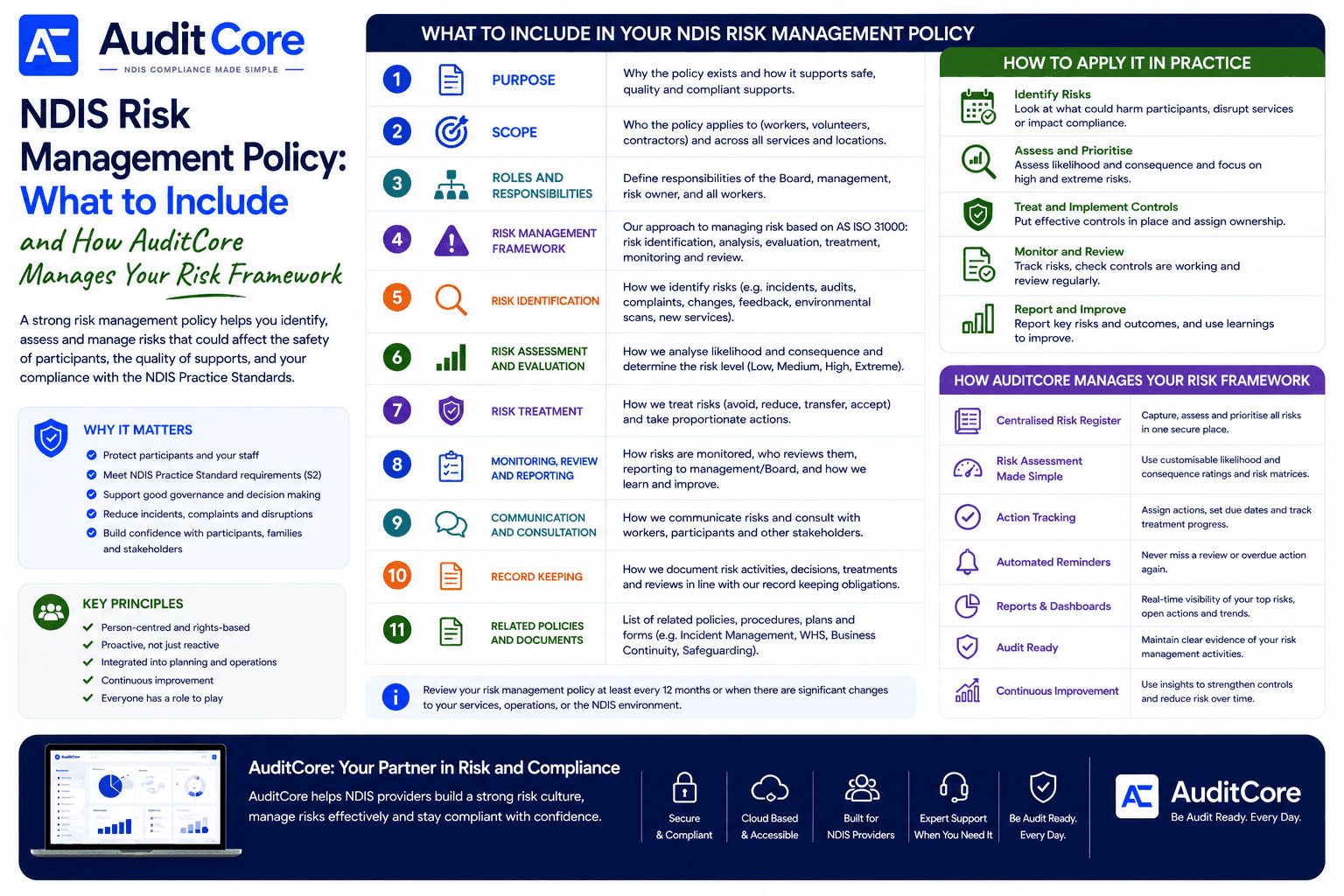
- Protect participants and your staff from foreseeable harm
- Meet NDIS Practice Standard requirements (Standard S2 — Governance and Operational Management)
- Support good governance and evidence-based decision making
- Reduce incidents, complaints and service disruptions
- Build confidence with participants, families and stakeholders
Key Principles of an Effective Risk Framework
- Person-centred and rights-based — risk management exists to protect participant safety and dignity
- Proactive, not just reactive — identify and treat risks before they become incidents
- Integrated into planning and operations — not a standalone document but part of how you work
- Continuous improvement — learnings from risks and incidents strengthen your controls over time
- Everyone has a role to play — from the Board to frontline workers
What Your Risk Management Policy Must Include
- Purpose — why the policy exists and how it supports safe, quality and compliant supports
- Scope — who the policy applies to (workers, volunteers, contractors) and across all services and locations
- Roles and Responsibilities — define responsibilities of the Board, management, risk owner, and all workers
- Risk Management Framework — your approach based on AS ISO 31000: risk identification, analysis, evaluation, treatment, monitoring and review
- Risk Identification — how you identify risks (e.g. incidents, audits, complaints, changes, feedback, environmental scans, new services)
- Risk Assessment and Evaluation — how you analyse likelihood and consequence and determine risk level (Low, Medium, High, Extreme)
- Risk Treatment — how risks are treated (avoid, reduce, transfer, accept) with proportionate actions
- Monitoring, Review and Reporting — how risks are monitored, who reviews them, Board reporting, and how you learn and improve
- Communication and Consultation — how you communicate risks and consult with workers, participants and other stakeholders
- Record Keeping — how you document risk activities, decisions, treatments and reviews in line with record keeping obligations
- Related Policies and Documents — list of related policies, procedures, plans and forms (e.g. Incident Management, WHS, Business Continuity, Safeguarding)
Review your risk management policy at least every 12 months — or sooner when there are significant changes to your services, operations, or the NDIS environment.
How to Apply Your Risk Framework in Practice
- 1Identify Risks — look at what could harm participants, disrupt services or impact compliance
- 2Assess and Prioritise — assess likelihood and consequence, and focus resources on high and extreme risks first
- 3Treat and Implement Controls — put effective controls in place and assign clear ownership to a named person
- 4Monitor and Review — track risks regularly, check controls are working, and update the register when things change
- 5Report and Improve — report key risks and outcomes to management and the Board, and use learnings to strengthen your framework
What Your Risk Register Must Show
AuditCore's Policy Library includes a pre-built NDIS Risk Management Policy template — mapped to Standard S2 and ready to customise for your organisation.
See the Policy Library →A risk register is the live document that puts your policy into practice. Auditors check that it is current, that risks have been reviewed, and that treatment actions have owners and due dates.
| Column | What to Include |
|---|---|
| Risk ID | Unique identifier for each risk |
| Risk description | Clear description of the risk event and its potential impact |
| Risk category | Participant safety, financial, operational, compliance, reputational |
| Likelihood | Rating (1–5) with justification |
| Consequence | Rating (1–5) with justification |
| Risk rating | Combined score (Extreme, High, Medium, Low) |
| Treatment action | Specific steps to mitigate the risk |
| Risk owner | Named individual responsible for the treatment |
| Review date | Date the risk was last reviewed |
| Status | Open, in progress, closed |
AuditCore's Internal Audit AI checks your risk management framework against NDIS Practice Standard S2 indicators — flagging gaps before your auditor does.
See Internal Audit AI →How AuditCore Manages Your Risk Framework
- Centralised Risk Register — capture, assess and prioritise all risks in one secure place
- Risk Assessment Made Simple — customisable likelihood and consequence ratings with built-in risk matrices
- Action Tracking — assign treatment actions, set due dates and track progress to completion
- Automated Reminders — never miss a review or overdue action again
- Reports and Dashboards — real-time visibility of your top risks, open actions and emerging trends
- Audit Ready Evidence — maintain clear, timestamped evidence of all risk management activities
- Continuous Improvement — use insights from risks and incidents to strengthen controls over time
How AuditCore Populates Your Risk Register Automatically
Every incident logged in AuditCore is analysed for risk implications. If an incident pattern emerges — three medication administration incidents in two months, for example — AuditCore flags it as a potential systematic risk and prompts you to create or update a risk register entry. Complaint patterns, audit findings, and CI Register items are linked to the risk register in the same way. The result is a risk register that actually reflects what is happening in your organisation.