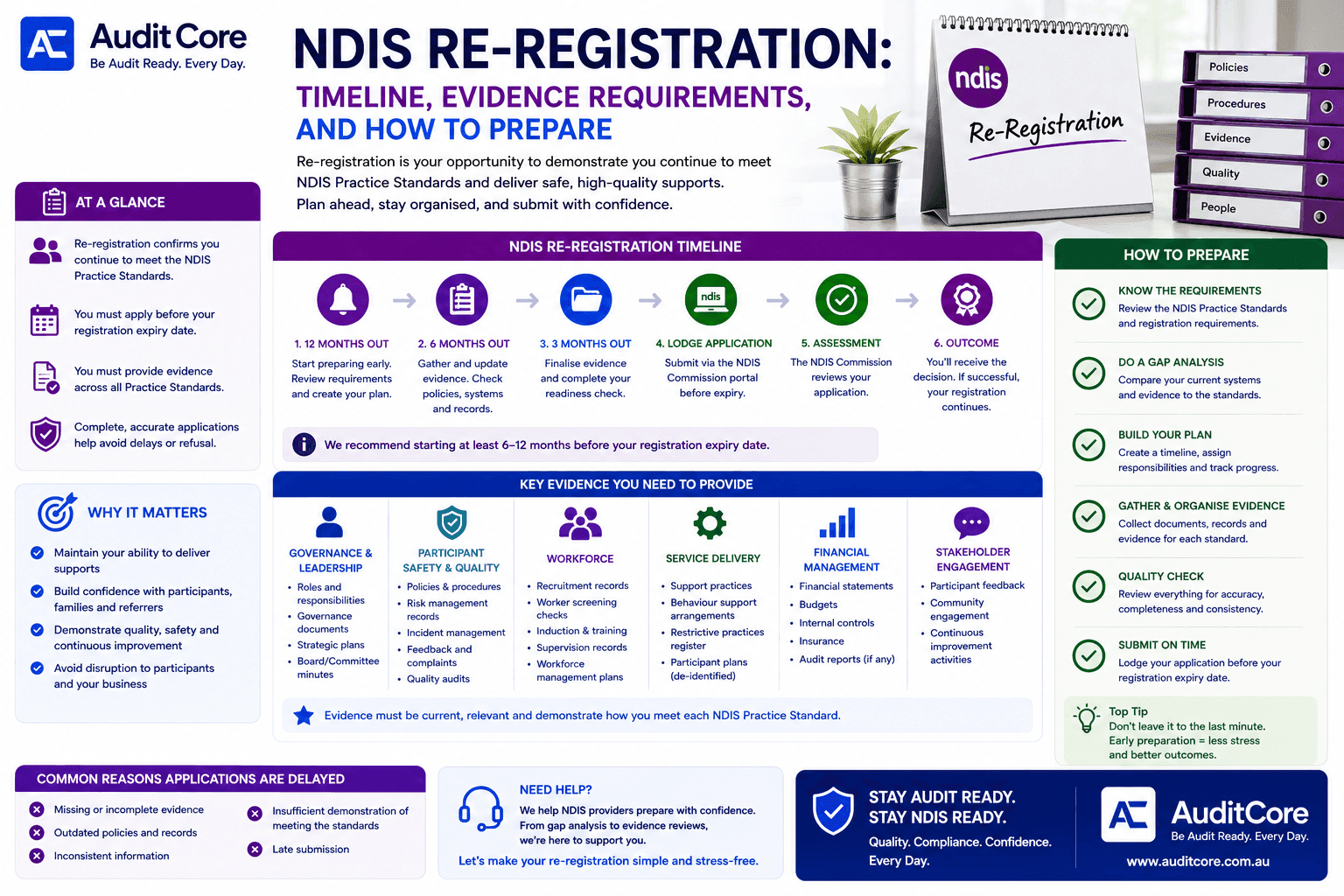
Every NDIS registered provider must re-register every three years. Re-registration is not automatic — it requires a formal application to the NDIS Quality and Safeguards Commission, a new quality audit by a Commission-approved auditor, and payment of the audit fee. Providers who treat re-registration as a routine renewal rather than a full audit cycle often discover significant compliance gaps when the auditor arrives.
At a Glance
- Re-registration confirms you continue to meet the NDIS Practice Standards and deliver safe, high-quality supports
- You must apply before your registration expiry date — late applications risk a lapse in registration
- You must provide evidence across all Practice Standards your organisation is registered under
- Complete, accurate applications with organised evidence help avoid delays, requests for more information, or refusal
Why Re-Registration Matters
- Maintain your ability to deliver supports — without current registration, you cannot provide NDIS-funded services
- Build confidence with participants, families and referrers — current registration signals quality and accountability
- Demonstrate quality, safety and continuous improvement — re-registration is your opportunity to show the Commission you have grown since your last audit
- Avoid disruption to participants and your business — a lapsed or revoked registration causes serious harm to participants who rely on your services
When Does Your Registration Expire?
Your registration expiry date is shown on your registration certificate and on the myplace provider portal. The Commission will send reminder notices, but these typically arrive 3-6 months before expiry. Do not wait for the reminder — check your expiry date now and work backwards to build your preparation timeline.
NDIS Re-Registration Timeline
| Stage | When | What You Must Do |
|---|---|---|
| 1 — Start Early | 12 months out | Start preparing early — review your registration requirements, check your expiry date, and create your preparation plan with assigned responsibilities |
| 2 — Gather Evidence | 6 months out | Gather and update evidence — check all policies, systems and records; address gaps identified in your internal audit |
| 3 — Finalise Readiness | 3 months out | Finalise your evidence portfolio and complete a full readiness check — everything must be current, consistent, and audit-ready |
| 4 — Lodge Application | Before expiry | Submit your re-registration application via the NDIS Commission portal (myplace) — do not wait until the last week |
| 5 — Assessment | Commission review | The NDIS Commission reviews your application and audit report — they may request additional information |
| 6 — Outcome | Decision issued | You receive the registration decision — if successful, your registration continues; if there are issues, you will receive conditions or a timeframe to remediate |
We recommend starting at least 6–12 months before your registration expiry date.
The Re-Registration Timeline — Detailed
12 Months Before Expiry — Start Internal Preparation
- Review all policies and procedures — check they have been reviewed in the past 12 months and are still current
- Run an internal audit against the Practice Standards you are registered for
- Review your incident register — identify any systemic issues auditors might flag
- Check all worker screening records — ensure every worker has a current NDIS Worker Screening Check
- Review worker training records — check mandatory training is current for all staff
- Review any behaviour support plans and restrictive practices authorisations for currency
9 Months Before Expiry — Remediate Gaps
- Address all gaps identified in your internal audit
- Update policies that are out of date
- Complete any lapsed worker training
- Renew expired worker screening checks and professional registrations
- Resolve any outstanding complaints or incidents with documented outcomes
- Ensure your governance structure (board minutes, meeting records) is documented
6 Months Before Expiry — Lodge Application and Engage Auditor
- Submit your re-registration application through the myplace provider portal
- Select a Commission-approved Quality Auditor (list available on the Commission website)
- Confirm the audit scope based on your registration groups — same standards as initial registration
- Schedule the audit date — good auditors book out; six months is not too early
- Gather your evidence portfolio — start compiling documents by practice standard
3 Months Before Expiry — Final Audit Preparation
- Conduct a pre-audit review with your team
- Ensure all staff know their roles during the audit
- Prepare a master index of your evidence documents
- Run a mock audit against the Practice Standards — identify any remaining gaps
- Brief key staff on likely audit questions for their areas
Audit Period
- Desktop review: Submit your document portfolio to the auditor
- Site visit (certification pathway): Auditor visits your office and service locations
- Participant and staff interviews: Auditors speak with participants, families, and workers
- Post-audit: Auditor provides findings — non-conformances require a corrective action plan
AuditCore's Internal Audit AI runs a practice standard gap analysis against your current documentation, identifying non-conformances before your external auditor does — so you have time to fix them.
See Internal Audit AI →Key Evidence You Need to Provide
Evidence must be current, relevant and demonstrate how you meet each NDIS Practice Standard. The six evidence areas auditors assess during re-registration are:
| Evidence Area | What to Include |
|---|---|
| Governance and Leadership | Roles and responsibilities documentation, governance documents (constitution, delegations), strategic plans, Board/Committee meeting minutes for the past 12 months |
| Participant Safety and Quality | Policies and procedures (reviewed within 12 months), risk management records, incident management register with Commission notifications, feedback and complaints register, quality audit evidence |
| Workforce | Recruitment records, worker screening check certificates (NDIS WSC and WWCC where required), induction and training records, supervision records, workforce management plans |
| Service Delivery | Support practice documentation, behaviour support arrangements and plans, restrictive practices register (if applicable), participant plans — de-identified sample |
| Financial Management | Financial statements, budgets and financial oversight evidence, internal controls documentation, current insurance certificates, external audit reports (if any) |
| Stakeholder Engagement | Participant feedback records and how they were acted on, community engagement evidence, continuous improvement activities linked to feedback and incidents |
Evidence Required by Registration Pathway
Verification Pathway (Lower-Risk Supports)
The verification pathway is for providers delivering lower-risk supports such as assistance with daily life, community participation, or transport. Evidence requirements include:
- Professional indemnity and public liability insurance certificates
- Evidence of relevant qualifications or experience for key personnel
- Policies and procedures relevant to the services delivered
- Worker screening check records
- A self-assessment against the Practice Standards
Certification Pathway (Higher-Risk Supports)
Providers delivering higher-risk supports must undergo a full certification audit. Evidence required typically includes:
- All policies and procedures — with evidence of annual review
- Governance documents — board constitution, meeting minutes for the past 12 months, financial statements
- Risk register and risk management framework
- Incident register — full 12-month history with evidence of Commission notifications
- Complaints register — 12-month history with documented responses
- Worker files — contracts, position descriptions, screening checks, training records, supervision records for a sample of workers
- Participant files — support plans, consents, communication records for a sample of participants
- Internal audit records — evidence of self-assessment against Practice Standards
- Continuous improvement register — documented improvements from incidents, complaints, and audits
How to Prepare: Six Steps
- 1Know the Requirements — Review the NDIS Practice Standards and your specific registration requirements before you do anything else; know exactly what you will be assessed against
- 2Do a Gap Analysis — Compare your current systems, policies, and evidence to each standard; identify what is missing, outdated, or insufficient
- 3Build Your Plan — Create a preparation timeline, assign responsibilities to specific team members, and track progress against milestones
- 4Gather and Organise Evidence — Collect documents, records and evidence for each standard; organise by Practice Standard so it is immediately accessible during audit
- 5Quality Check — Review everything for accuracy, completeness and consistency; evidence that contradicts your policies is worse than no evidence at all
- 6Submit on Time — Lodge your application before your registration expiry date; do not leave it to the last minute — early preparation means less stress and better outcomes
What Happens If You Have Non-Conformances?
Non-conformances are formal findings that you have not met one or more Practice Standards. They are graded:
- Minor non-conformance: An isolated failure with low risk. Requires a corrective action plan within 90 days.
- Major non-conformance: A systemic failure or one with significant risk to participants. Requires immediate corrective action. May delay registration renewal.
- Critical non-conformance: A failure posing immediate serious risk. Registration may be suspended pending remediation.
Having non-conformances does not automatically mean you fail re-registration — it depends on the type and number. But major and critical non-conformances require fast, documented responses with evidence of resolution.
AuditCore's Continuous Improvement Register documents every corrective action from audits, incidents, and complaints — giving auditors the evidence trail they need to see that your organisation learns and improves.
See CI Register →Common Reasons Applications Are Delayed or Refused
- Missing or incomplete evidence — the most common reason for delays; auditors cannot assess compliance without evidence
- Outdated policies and records — policies not reviewed in the past 12 months are a finding before the auditor asks a single question
- Inconsistent information — evidence that contradicts your policies or registers raises serious concerns about record integrity
- Insufficient demonstration of meeting the standards — describing what you intend to do is not the same as demonstrating what you actually do
- Late submission — applying after your expiry date means a lapse in registration; Commission processing takes time
- Incident notifications not submitted to the Commission within required timeframes
- Worker screening checks expired or incomplete for all workers
- No documented internal audit in the past 12 months
- Governance failures — board does not have documented oversight of compliance