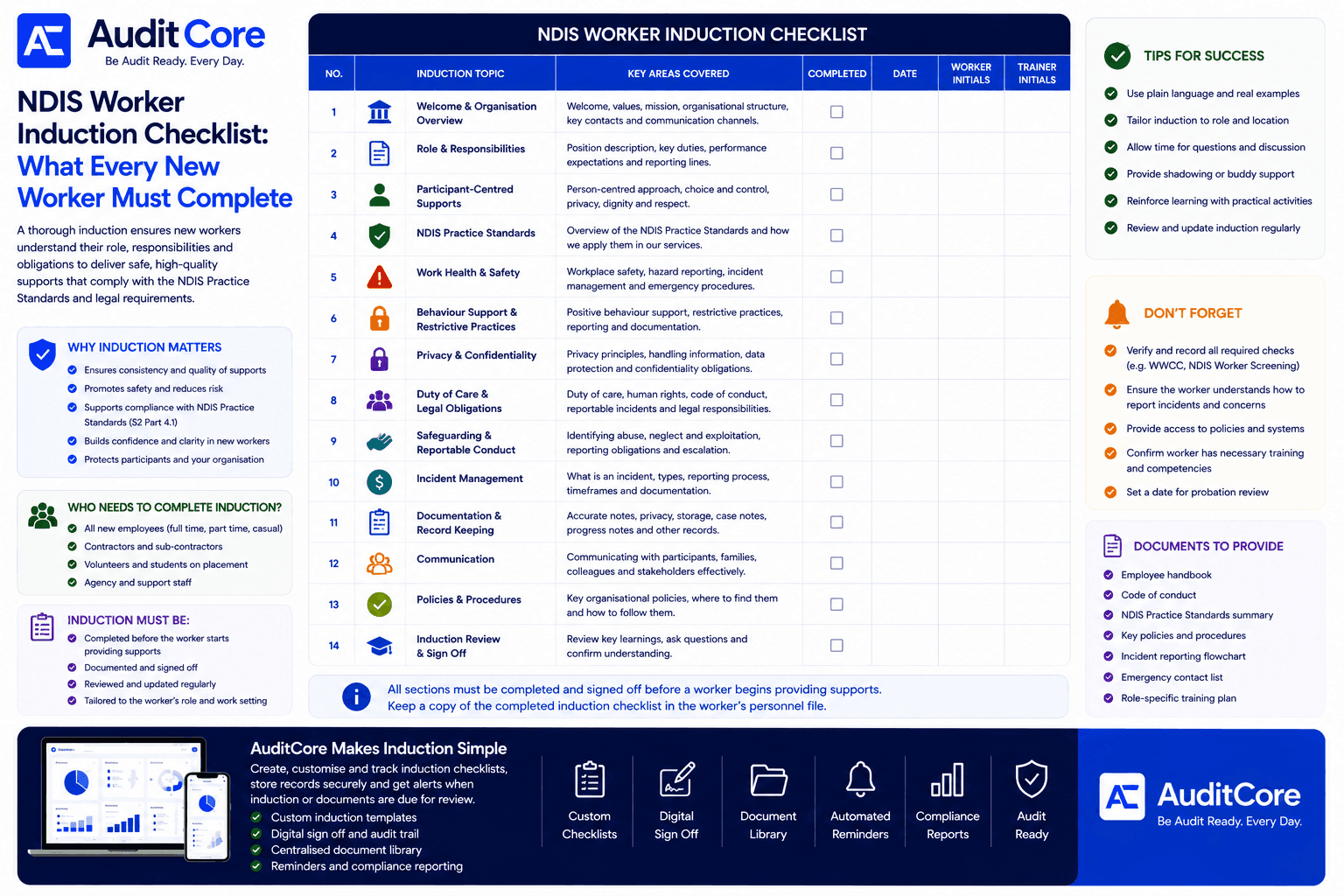
NDIS Practice Standard 2.6 requires that all workers are properly inducted before they begin working with participants. A worker who starts providing supports without completing induction — even an experienced support worker from another provider — is a compliance gap that auditors find and flag. AuditCore tracks induction completion for every worker with a signed, dated record.
Why Induction Matters
- Ensures consistency and quality of supports across your entire workforce
- Promotes safety and reduces risk for participants and workers alike
- Supports compliance with NDIS Practice Standards (S2 Part 4.1) — auditors check induction records
- Builds confidence and clarity in new workers before they begin working with participants
- Protects participants and your organisation from the risks of unprepared workers
Who Needs to Complete Induction?
- All new employees — full time, part time, and casual
- Contractors and sub-contractors who will work with participants
- Volunteers and students on placement
- Agency and support staff engaged to deliver supports
Induction Must Be
- Completed before the worker starts providing supports to any participant
- Documented and signed off by both the worker and a trainer or supervisor
- Reviewed and updated regularly to reflect current practice standards and legislation
- Tailored to the worker's specific role and work setting
The 14 Essential Induction Topics
| # | Induction Topic | Key Areas Covered |
|---|---|---|
| 1 | Welcome & Organisation Overview | Welcome, values, mission, organisational structure, key contacts and communication channels |
| 2 | Role & Responsibilities | Position description, key duties, performance expectations and reporting lines |
| 3 | Participant-Centred Supports | Person-centred approach, choice and control, privacy, dignity and respect |
| 4 | NDIS Practice Standards | Overview of the NDIS Practice Standards and how we apply them in our services |
| 5 | Work Health & Safety | Workplace safety, hazard reporting, incident management and emergency procedures |
| 6 | Behaviour Support & Restrictive Practices | Positive behaviour support, restrictive practices, reporting and documentation |
| 7 | Privacy & Confidentiality | Privacy principles, handling information, data protection and confidentiality obligations |
| 8 | Duty of Care & Legal Obligations | Duty of care, human rights, code of conduct, reportable incidents and legal responsibilities |
| 9 | Safeguarding & Reportable Conduct | Identifying abuse, neglect and exploitation, reporting obligations and escalation |
| 10 | Incident Management | What is an incident, types, reporting process, timeframes and documentation |
| 11 | Documentation & Record Keeping | Accurate notes, privacy, storage, case notes, progress notes and other records |
| 12 | Communication | Communicating with participants, families, colleagues and stakeholders effectively |
| 13 | Policies & Procedures | Key organisational policies, where to find them and how to follow them |
| 14 | Induction Review & Sign Off | Review key learnings, ask questions and confirm understanding |
All sections must be completed and signed off before a worker begins providing supports. Keep a copy of the completed induction checklist in the worker's personnel file.
What Must Be Covered in NDIS Worker Induction
Organisation and Governance
- Organisational structure and key contacts
- Code of conduct and expected behaviours
- Relevant policies and how to access them
- Privacy and confidentiality obligations
- Conflict of interest policy
AuditCore's Worker Compliance module stores induction records, screening checks, and mandatory training completions for every staff member — giving auditors instant evidence of your HR compliance.
See Worker Compliance →NDIS Framework and Participant Rights
- NDIS Practice Standards overview
- Participant rights and the NDIS Code of Conduct
- Person-centred approaches and what they mean in practice
- Zero tolerance for abuse, neglect, exploitation, and discrimination
- Mandatory reporting obligations
Safety and Incident Management
- How to report an incident — the form, the process, the timeframes
- What makes an incident reportable to the NDIS Commission
- Emergency procedures for each work location
- Manual handling and infection control
- Work health and safety obligations
Specific Role Requirements
- The participants they will be working with and any individual support requirements
- Medication administration requirements (if applicable)
- Mealtime management requirements (if applicable)
- Behaviour support plan requirements (if applicable)
- Reporting and documentation requirements for their role
Documents to Provide at Induction
- Employee handbook
- Code of conduct
- NDIS Practice Standards summary
- Key policies and procedures
- Incident reporting flowchart
- Emergency contact list
- Role-specific training plan
Tips for Effective Induction
- Use plain language and real examples — avoid jargon and bureaucratic language that confuses new workers
- Tailor induction to the worker's specific role and location — a day program worker needs different context than an in-home support worker
- Allow time for questions and discussion — induction is a two-way process, not just information delivery
- Provide shadowing or buddy support so new workers can apply what they have learned alongside an experienced colleague
- Reinforce learning with practical activities — scenario-based exercises are far more effective than passive reading
- Review and update induction content regularly — outdated induction is a compliance risk
Documentation Requirements
Induction completion must be documented — a signed induction checklist with the date and the worker's name. This document is what auditors look for. A verbal induction with no record is the same as no induction in the eyes of an auditor. AuditCore stores a signed digital induction record for every worker, timestamped and linked to their worker profile.
Induction vs. Ongoing Training
Induction covers what a worker needs to know before they start. Ongoing training covers what they need to maintain and develop. AuditCore tracks both — induction completion for new workers and mandatory training currency for existing workers, including refresher training on key topics like incident reporting and participant rights.
How AuditCore Makes Induction Simple
When a new worker is added to AuditCore, the system automatically creates an induction task list based on your configured requirements. The worker's profile shows induction status — incomplete, in progress, or complete — and the compliance dashboard flags any worker who is providing supports before induction is fully documented. Managers receive an alert if a worker's induction record is missing.
- Custom induction checklists — tailored to role, location, and service type
- Digital sign off — workers and trainers sign on-screen with timestamp and audit trail
- Centralised document library — induction materials stored and version-controlled in one place
- Automated reminders — alerts when induction is incomplete or when refresher training is due
- Compliance reports — real-time view of induction status across your entire workforce
- Audit ready — every induction record retrievable in seconds during an NDIS audit