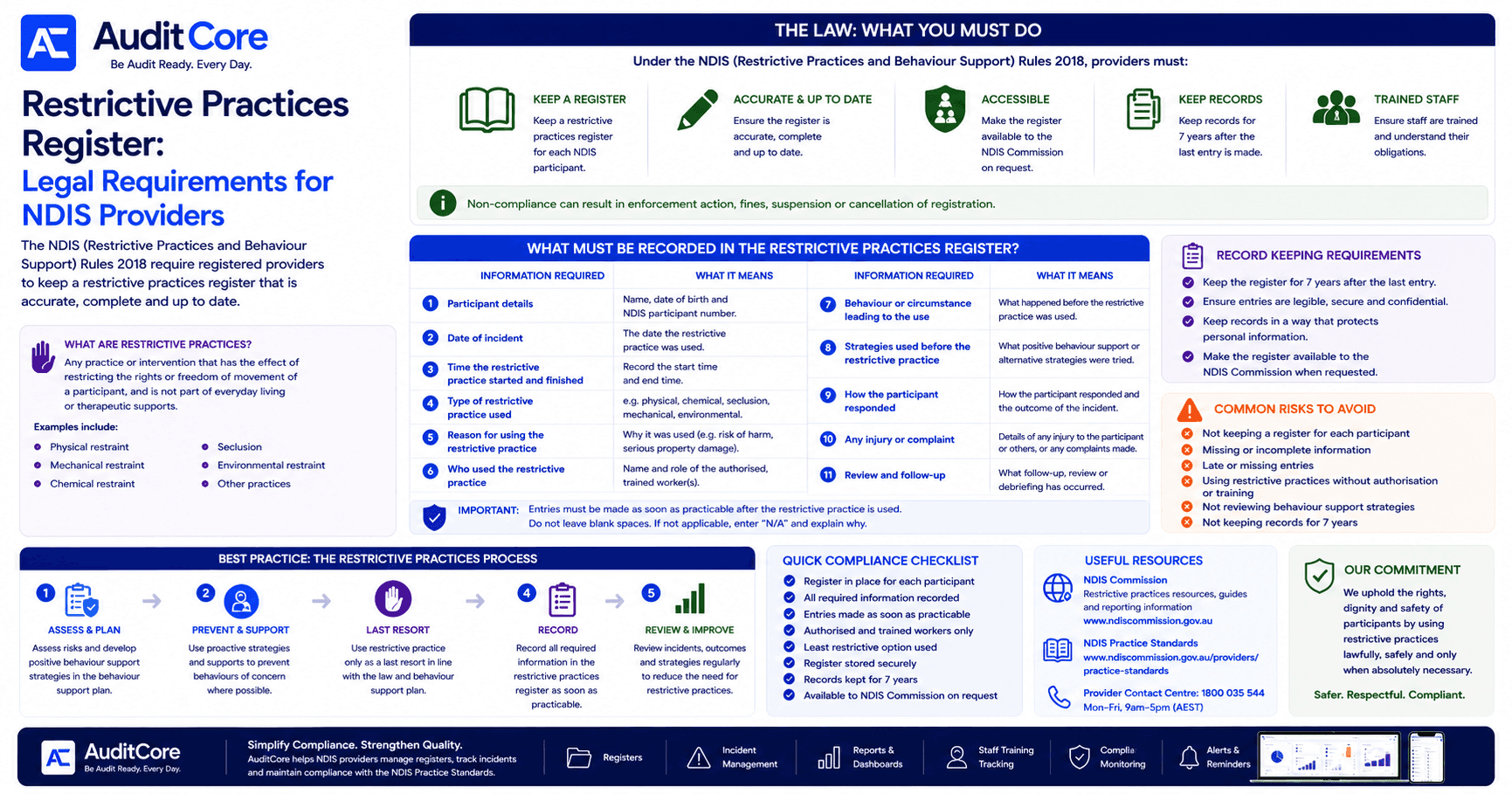
NDIS providers who implement regulated restrictive practices are required to maintain accurate records of every instance of use and report this data to the NDIS Quality and Safeguards Commission monthly. A restrictive practices register is the document that captures this information — and it is one of the first things a Commission auditor will request.
The Law: What You Must Do
Under the NDIS (Restrictive Practices and Behaviour Support) Rules 2018, providers must:
| Legal Obligation | What It Requires |
|---|---|
| Keep a Register | Keep a restrictive practices register for each NDIS participant for whom a restrictive practice is used — one register per participant, not a single combined register |
| Accurate and Up to Date | Ensure the register is accurate, complete and up to date — entries must be made as soon as practicable after each use |
| Accessible | Make the register available to the NDIS Commission on request — it must be retrievable and readable at any time |
| Keep Records for 7 Years | Keep records for 7 years after the last entry is made — longer for records relating to children (until the person turns 25) |
| Trained Staff | Ensure staff are trained and understand their obligations — only authorised, trained workers can implement restrictive practices |
Non-compliance can result in enforcement action, fines, suspension or cancellation of registration.
What Is a Regulated Restrictive Practice?
Under the National Disability Insurance Scheme (Restrictive Practices and Behaviour Support) Rules 2018, five categories of restrictive practice are regulated:
- Seclusion
- Chemical restraint
- Mechanical restraint
- Physical restraint
- Environmental restraint
Any provider implementing one or more of these must have a register. The register covers every participant for whom a restrictive practice is used — even if it is a single participant, even if it is used infrequently.
What Must Be Recorded in the Restrictive Practices Register?
There is no single prescribed template, but the following 11 items must be captured for every instance of restrictive practice use:
| # | Information Required | What It Means |
|---|---|---|
| 1 | Participant details | Name, date of birth and NDIS participant number |
| 2 | Date of incident | The date the restrictive practice was used |
| 3 | Time started and finished | Record the exact start time and end time of the restrictive practice |
| 4 | Type of restrictive practice used | e.g. physical, chemical, seclusion, mechanical, environmental |
| 5 | Reason for using the restrictive practice | Why it was used — e.g. risk of harm, serious property damage, immediate safety threat |
| 6 | Who used the restrictive practice | Name and role of the authorised, trained worker(s) who implemented it |
| 7 | Behaviour or circumstance leading to the use | What happened before the restrictive practice was used — the trigger or antecedent |
| 8 | Strategies used before the restrictive practice | What positive behaviour support or alternative strategies were tried first |
| 9 | How the participant responded | How the participant responded and the outcome of the incident |
| 10 | Any injury or complaint | Details of any injury to the participant or others, or any complaints made |
| 11 | Review and follow-up | What follow-up, review or debriefing has occurred after the incident |
IMPORTANT: Entries must be made as soon as practicable after the restrictive practice is used. Do not leave blank spaces — if an item is not applicable, enter "N/A" and explain why.
What Must the Register Include?
Per Participant
- Participant name and NDIS number
- The type(s) of restrictive practice in use
- The authorisation reference — the state/territory approval document, tribunal order, or equivalent
- The authorisation expiry date
- The name of the behaviour support practitioner and the date the current behaviour support plan was approved
- The reduction plan goals and target dates
Per Instance of Use
- Date and time of the restrictive practice
- Duration
- Type of restrictive practice used
- Reason/trigger — what behaviour of concern occurred
- Worker who implemented the practice
- Any injuries or adverse outcomes
- Whether the instance was reported as part of monthly Commission reporting
- Any post-incident follow-up or debrief conducted
AuditCore's Behaviour Support module maintains your restrictive practices register automatically — every instance logged by workers is captured with timestamp, worker ID, and outcome, ready for Commission reporting.
See Behaviour Support →Record Keeping Requirements
- Keep the register for 7 years after the last entry — longer for records relating to participants who were children at the time
- Ensure entries are legible, secure and confidential — digital registers with access controls are strongly recommended
- Keep records in a way that protects personal information — in line with privacy legislation
- Make the register available to the NDIS Commission when requested — at any time, not just during scheduled audits
Best Practice: The Restrictive Practices Process
- 1Assess and Plan — Assess risks and develop positive behaviour support strategies in the behaviour support plan before any restrictive practice is considered
- 2Prevent and Support — Use proactive strategies and supports to prevent behaviours of concern where possible — restrictive practices are always the last option
- 3Last Resort — Use restrictive practice only as a last resort in line with the law and the behaviour support plan, with valid authorisation in place
- 4Record — Record all 11 required items in the restrictive practices register as soon as practicable after each use
- 5Review and Improve — Review incidents, outcomes and strategies regularly to reduce the need for restrictive practices and demonstrate a declining trend
Monthly Reporting to the NDIS Commission
Providers who use regulated restrictive practices must submit a monthly report to the Commission via the provider portal (myplace). This report must be submitted even if no restrictive practices were used that month — a nil report is still required. The report covers:
- Each participant for whom restrictive practices were used or are authorised
- The frequency and type of restrictive practice used
- Any incidents associated with restrictive practice use
- Progress against the reduction plan
Failure to submit monthly reports is one of the most common compliance breaches identified by the Commission. It is a civil penalty offence. Providers with multiple missed reports face escalating enforcement action.
Authorisation Requirements by State and Territory
Authorisation for regulated restrictive practices is a state and territory responsibility, not a Commonwealth one. Each jurisdiction has its own legal framework:
- NSW: Guardianship Tribunal or NSW Civil and Administrative Tribunal (NCAT)
- VIC: Victorian Civil and Administrative Tribunal (VCAT) or Senior Practitioner
- QLD: Queensland Civil and Administrative Tribunal (QCAT) or Public Guardian
- SA: South Australian Civil and Administrative Tribunal (SACAT) or Public Advocate
- WA: State Administrative Tribunal (SAT) or Public Advocate
- ACT: ACT Civil and Administrative Tribunal (ACAT)
- TAS: Guardianship and Administration Board
- NT: Northern Territory Civil and Administrative Tribunal (NTCAT)
Your register must reference the specific authorisation document from the relevant body — a general notation that the practice is 'approved' without a formal authorisation reference is not compliant.
What Auditors Look For
When a Commission auditor reviews your restrictive practices register, they check:
- Is the register current? Does it reflect all participants currently receiving supports involving restrictive practices?
- Is every authorisation on file and current — not expired?
- Are monthly Commission reports consistent with the register — same participants, same practice types?
- Are instances of use documented individually, or just as a monthly summary?
- Are incidents involving restrictive practices cross-referenced with incident reports?
- Is there a documented reduction trajectory — are restrictive practice rates declining over time?
Quick Compliance Checklist
- Register in place and maintained for each participant
- All 11 required items of information recorded for every instance
- Entries made as soon as practicable — no delayed or retrospective entries
- Authorised and trained workers only implementing restrictive practices
- Least restrictive option used and documented as such
- Register stored securely with access restricted to authorised personnel
- Records kept for 7 years (or longer for child participants)
- Register available to NDIS Commission on request at any time
Common Risks to Avoid
- Not keeping a separate register for each participant — one combined register for multiple participants is not compliant
- Missing or incomplete information — blank fields and vague entries are audit findings
- Late or missing entries — recording must happen as soon as practicable, not at the end of the week
- Using restrictive practices without authorisation or by untrained workers — both are reportable incidents
- Not reviewing behaviour support strategies — a register without a reduction trend demonstrates no improvement effort
- Not keeping records for 7 years — early destruction of records is a compliance breach even if unintentional
Emergency and Unplanned Restrictive Practice Use
Sometimes workers need to use a restrictive practice in an emergency before authorisation is obtained. This is permitted under the NDIS rules in limited circumstances, but it triggers additional obligations:
- The incident must be reported to the Commission as a reportable incident within 24 hours
- The provider must apply for authorisation immediately — emergency use cannot continue beyond the acute situation
- A behaviour support practitioner must be involved immediately to develop or update the behaviour support plan
- The use must be recorded in the register with a specific notation that it was unplanned emergency use
Record Retention
NDIS providers must retain records related to restrictive practices for a minimum of 7 years. For records relating to children, retention extends until the person turns 25. These records must be available to the Commission on request.
AuditCore's Continuous Improvement Register tracks reduction plan progress for every participant, with trend data showing whether restrictive practice use is declining — the evidence auditors need to see.
See CI Register →