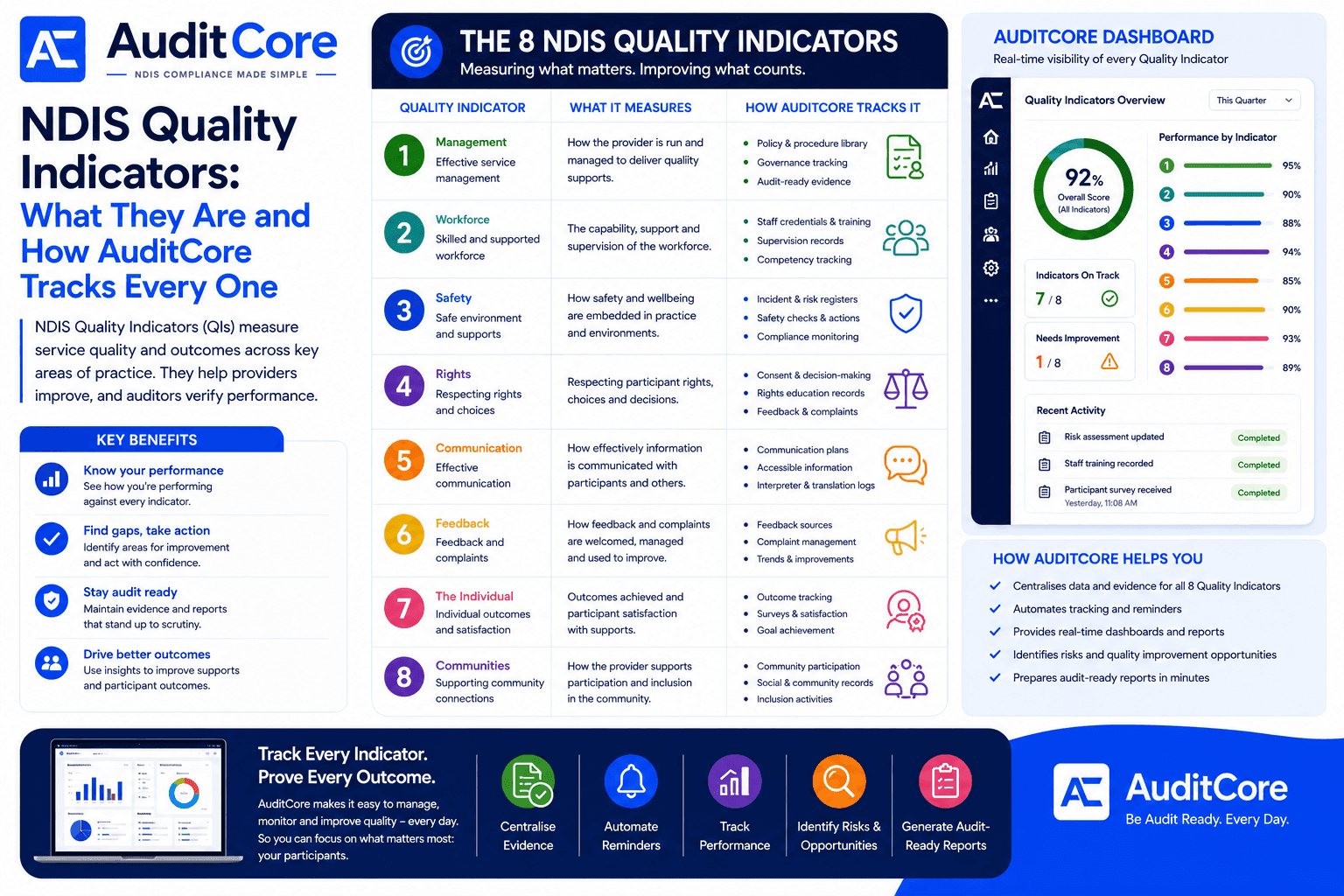
NDIS Quality Indicators (QIs) measure service quality and outcomes across key areas of practice. They help providers improve performance and give auditors a structured way to verify compliance. NDIS auditors do not simply check whether you meet the four Practice Standards — they assess you against specific quality indicators within each standard. AuditCore maps every quality indicator to your operational data and produces a real-time compliance score for each one.
Key Benefits of Tracking Quality Indicators
- Know your performance — see how you are performing against every indicator in real time
- Find gaps and take action — identify areas for improvement and act with confidence before an audit
- Stay audit ready — maintain evidence and reports that stand up to auditor scrutiny
- Drive better outcomes — use insights to improve supports and participant outcomes
The 8 NDIS Quality Indicators
| Quality Indicator | What It Measures | How AuditCore Tracks It |
|---|---|---|
| 1. Management — Effective service management | How the provider is run and managed to deliver quality supports | Policy and procedure library; Governance tracking; Audit-ready evidence |
| 2. Workforce — Skilled and supported workforce | The capability, support and supervision of the workforce | Staff credentials and training; Supervision records; Competency tracking |
| 3. Safety — Safe environment and supports | How safety and wellbeing are embedded in practice and environments | Incident and risk registers; Safety checks and actions; Compliance monitoring |
| 4. Rights — Respecting rights and choices | Respecting participant rights, choices and decisions | Consent and decision-making; Rights education records; Feedback and complaints |
| 5. Communication — Effective communication | How effectively information is communicated with participants and others | Communication plans; Accessible information; Interpreter and translation logs |
| 6. Feedback — Feedback and complaints | How feedback and complaints are welcomed, managed and used to improve | Feedback sources; Complaint management; Trends and improvements |
| 7. The Individual — Individual outcomes and satisfaction | Outcomes achieved and participant satisfaction with supports | Outcome tracking; Surveys and satisfaction; Goal achievement |
| 8. Communities — Supporting community connections | How the provider supports participation and inclusion in the community | Community participation; Social and community records; Inclusion activities |
Quality Indicators vs. Practice Standards — What Is the Difference?
The Practice Standards (S1–S4) are the broad categories. Each standard contains multiple quality indicators that describe specific behaviours, systems, or evidence. Think of the standards as chapters and the quality indicators as the specific requirements within each chapter. An auditor assessing your governance compliance is not just checking whether you have governance — they are assessing each quality indicator within S2 individually.
S1 Quality Indicators — Rights and Responsibilities
AuditCore monitors all NDIS quality indicators automatically — tracking your compliance status against every indicator across S1, S2, S3, S4 and the Behaviour Support standard in real time.
See Quality Indicator Tracking →- 1.1 Person-centred approaches — supports reflect individual goals and preferences
- 1.2 Privacy, dignity and confidentiality — information handled securely, consent obtained
- 1.3 Independence and informed choice — participants make informed decisions without coercion
- 1.4 VANED safeguarding — systems to prevent and respond to abuse and neglect
- 1.5 Responsive support provision — supports adapt to changing participant circumstances
S2 Quality Indicators — Governance
- 2.1 Governance and accountability
- 2.2 Risk management
- 2.3 Quality management and continuous improvement
- 2.4 Information management
- 2.5 Incident and complaint management
- 2.6 Human resources and worker screening
- 2.7 Continuity of supports
S3 Quality Indicators — Provision of Supports
- 3.1 Support planning with participants
- 3.2 Assessment and planning processes
- 3.3 Transitions between providers
S4 Quality Indicators — Support Environment
- 4.1 Safe and accessible environment
- 4.2 Emergency and disaster management
How AuditCore Helps You Track Every Indicator
- Centralises data and evidence for all 8 Quality Indicators in one platform
- Automates tracking and sends reminders when action is needed
- Provides real-time dashboards and reports showing your score per indicator
- Identifies risks and quality improvement opportunities before they become audit findings
- Prepares audit-ready reports in minutes — no manual compilation
How AuditCore Monitors Every Quality Indicator
AuditCore's Internal Audit AI scores your compliance against every quality indicator using your live operational data — participant records, worker checks, incident logs, policies, and governance documents. The audit dashboard displays a score for each indicator and highlights those that need attention. When a quality indicator score drops below your compliance threshold, AuditCore generates an alert and a recommended action. Track every indicator. Prove every outcome.