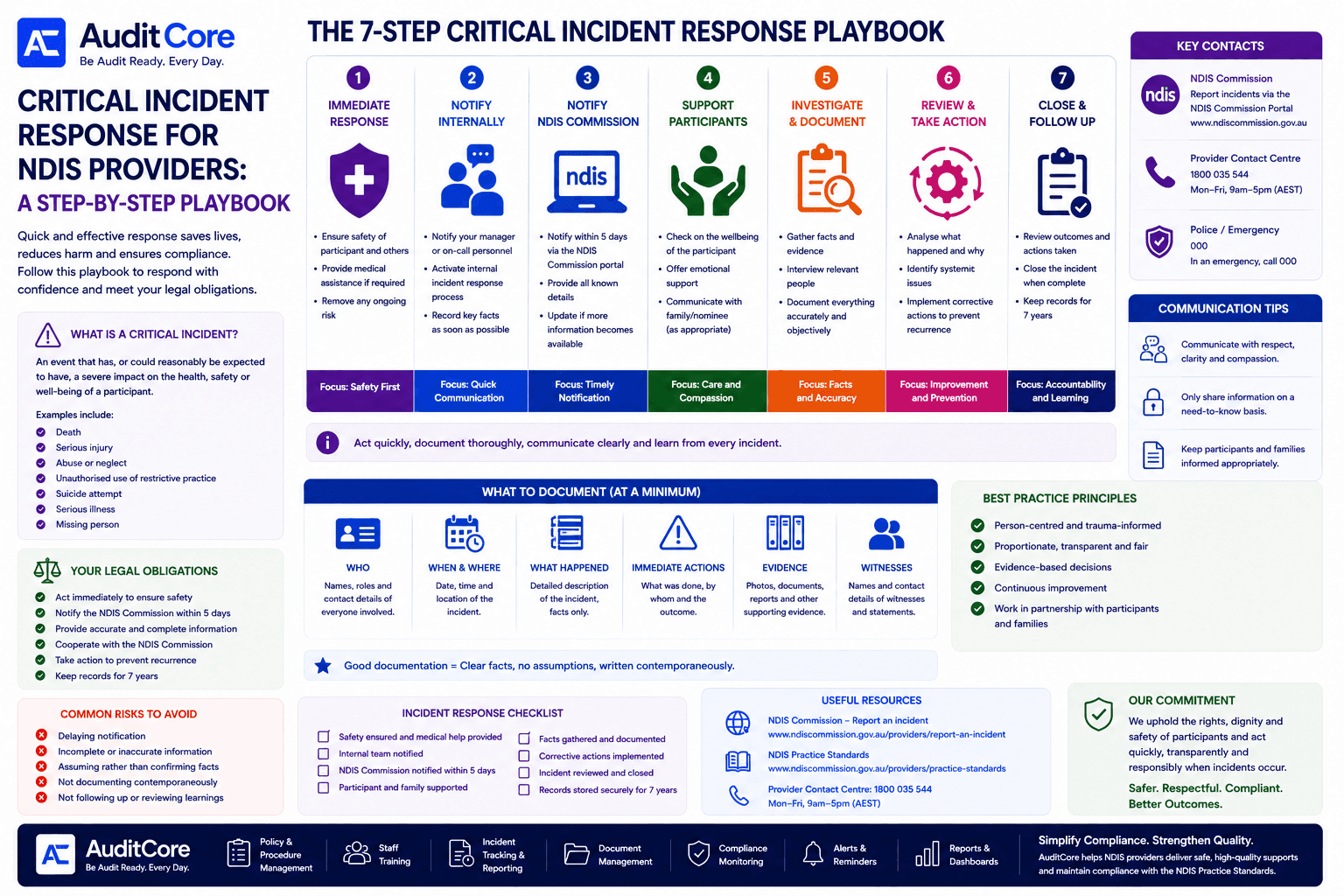
A critical incident is not the time to be reading policy documents or searching for forms. Every member of your team should know the response sequence before an incident occurs. This playbook covers the steps from the moment an incident is discovered through to Commission notification, internal review, and corrective action — in the order you need to execute them.
What Is a Critical Incident?
A critical incident is any event or situation that has caused, or has the potential to cause, serious harm to a participant or others. Under the NDIS (Incident Management and Reportable Incidents) Rules 2018, registered providers must have systems to identify, manage, and report critical incidents.
- Death of a participant
- Serious injury requiring hospitalisation or emergency treatment
- Abuse or neglect of a participant
- Unauthorised use of a restrictive practice
- Attempted suicide or self-harm
- Serious illness related to service delivery
- A participant going missing from a service
The 7-Step Critical Incident Response Playbook
| Step | Action | Key Focus |
|---|---|---|
| 1 | Immediate Response | Safety First — remove threats, call 000 if needed, provide first aid |
| 2 | Notify Internally | Quick Communication — alert supervisor within 1 hour, escalate to management |
| 3 | Notify NDIS Commission | Timely Notification — 24 hours for serious incidents, 5 days for others |
| 4 | Support Participants | Care and Compassion — trauma-informed support, contact guardian/family |
| 5 | Investigate & Document | Facts and Accuracy — contemporaneous records, objective language, preserve evidence |
| 6 | Review & Take Action | Improvement and Prevention — root cause analysis, corrective actions with due dates |
| 7 | Close & Follow Up | Accountability and Learning — submit full report, update CI register, verify actions complete |
Your Legal Obligations
As a registered NDIS provider, you have six core legal obligations when a critical incident occurs:
- 1Act immediately to ensure the safety of the participant and others
- 2Notify the NDIS Commission within the required timeframe (24 hours or 5 business days depending on severity)
- 3Provide accurate and complete information — do not minimise or omit relevant facts
- 4Cooperate fully with any NDIS Commission investigation or review
- 5Take action to prevent recurrence — implement corrective actions and monitor effectiveness
- 6Keep records for a minimum of 7 years from the date of the incident
Step 1: Ensure Safety (0-15 Minutes)
Before anything else, address immediate risk:
- Remove any ongoing threat to the participant or others
- Call emergency services (000) if there is a risk to life or serious injury requires medical treatment
- Provide first aid if safe to do so and you are trained
- Do not move a participant who may have a spinal injury unless there is a greater immediate threat
- Secure the scene — preserve any physical evidence if there may be a later investigation
- Separate witnesses and involved parties if multiple people are present
Step 2: Notify Your Supervisor (Within 1 Hour)
The worker involved must notify their direct supervisor immediately. The supervisor then determines whether the incident meets the Commission's definition of a reportable incident. This decision should not be made alone — escalate to management for any incident involving:
- Death of a participant
- Serious injury to a participant
- Abuse, neglect, or exploitation of a participant
- Unlawful sexual or physical contact with a participant
- Unexplained absence of a participant from a service
- A participant's use of chemical, mechanical, physical, environmental, or seclusion restraint not in their behaviour support plan
If in doubt, treat it as reportable. You can withdraw a notification, but you cannot retroactively submit one after the deadline has passed.
Step 3: Support the Participant (Ongoing)
While the administrative response unfolds, someone must be focused on the participant's welfare:
- Ensure they receive appropriate medical attention if needed
- Contact the participant's emergency contact or guardian as soon as practicable
- Provide trauma-informed support — do not leave them alone unless it is their preference
- Document the participant's condition and emotional state at each check
- Respect their right to privacy — limit who knows about the incident to those with a need to know
AuditCore's Incident Management module guides workers through the immediate response steps, automatically calculates your Commission notification deadline, and generates the notification template.
See Incident Management →Step 4: Document the Incident (Within 2 Hours)
Contemporaneous documentation is critical. A record written within hours of an incident carries significantly more weight than one written the next day. The initial incident record should capture:
- Date, time, and location of the incident
- Who was present — participant(s), worker(s), any others
- What happened — a factual, objective account without opinion or speculation
- What immediate actions were taken
- The participant's condition and response
- Any witnesses and their initial accounts
- Any injuries — participant, worker, or others
- Whether emergency services were called and their response
Use objective language. 'The participant sustained a bruise approximately 4cm in diameter on the left forearm' is better than 'the participant was hurt.' Facts are more defensible than interpretations.
Step 5: Notify the NDIS Commission (Within 24 Hours or 5 Days)
The notification timeframe depends on the type of incident:
- Within 24 hours: Death of a participant while receiving your supports; physical or sexual abuse of a participant; serious injury requiring hospitalisation or emergency medical treatment; unlawful deprivation of freedom
- Within 5 business days: All other reportable incidents — less serious injuries, unexplained absences, other abuse or neglect, incidents involving unplanned use of restrictive practices
Notification is made through the myplace provider portal. The initial notification does not need to be a complete investigation report — you are notifying the Commission that an incident has occurred. A full report follows later.
Step 6: Notify Other Required Parties
Depending on the incident type, you may need to notify:
- The participant's guardian or emergency contact — usually within hours
- Your insurer — especially for any incident involving potential liability
- State or territory police — for criminal incidents (assault, sexual offences, serious theft)
- State child protection services — if a child is involved
- The NDIA — if the incident may affect the participant's plan or funding
- Your professional indemnity insurer if a worker is implicated in wrongdoing
Step 7: Preserve and Secure Evidence
If there is any possibility of a formal investigation:
- Do not delete CCTV footage — preserve it and document who has access
- Retain any physical items relevant to the incident
- Collect written statements from workers involved while memories are fresh — within 24 hours if possible
- Do not share documentation beyond those who need it for response purposes
- If the incident may involve a worker committing an offence, consider whether the worker should be stood down pending investigation
Step 8: Conduct a Post-Incident Review (Within 5-10 Business Days)
After immediate obligations are met, conduct a formal post-incident review:
- Convene the review with the relevant manager, team leader, and any workers directly involved
- Use a root cause analysis framework — what were the contributing factors, not just the immediate cause?
- Identify what systems, processes, or environmental factors contributed to the incident
- Develop corrective actions — specific, measurable, assigned to a named person with a due date
- Update the incident record with review findings and corrective actions
- Record corrective actions in your continuous improvement register
AuditCore automatically creates a continuous improvement task from every incident, assigns it to a manager, and tracks completion — so corrective actions are never forgotten.
See CI Register →Step 9: Submit the Completed Incident Report to the Commission
Within 5 business days of initial notification, you must submit a more complete report via the provider portal. This should include the outcome of your initial investigation and the corrective actions you have taken or planned. The Commission may follow up with questions or request additional documentation.
What Not To Do
- Do not coach workers on what to say — allow independent accounts
- Do not delay notification to 'investigate first' — notify within timeframes and investigate concurrently
- Do not use incident documentation to assign blame before investigation is complete
- Do not notify in a way that minimises the severity — the Commission cross-references subsequent information
- Do not destroy or modify any records after an incident has occurred
What to Document: The Minimum Standard
Every critical incident record must capture information across six dimensions. Incomplete documentation is one of the most common non-conformances identified at audit:
| Category | What to Record |
|---|---|
| WHO | Names and roles of all persons involved; contact details of workers and participant; guardian or emergency contact notified |
| WHEN & WHERE | Exact date and time the incident occurred; exact location (address, room, environment type) |
| WHAT HAPPENED | Detailed factual description of the incident; facts only — no opinions, assumptions, or interpretations |
| IMMEDIATE ACTIONS | What was done in response; by whom and in what order; outcome of each action taken |
| EVIDENCE | Photos or physical evidence secured; CCTV footage preserved; relevant documents attached |
| WITNESSES | Full names and contact details of witnesses; written statements obtained within 24 hours |
Best Practice Principles
Leading NDIS providers approach incident response with these five principles embedded in their culture:
- Person-centred and trauma-informed — the participant's wellbeing and dignity comes before paperwork
- Proportionate, transparent, and fair — respond to the facts, not assumptions about blame
- Evidence-based decisions — investigate before concluding; document before discussing
- Continuous improvement — every incident is an opportunity to strengthen systems and protect future participants
- Work in partnership — involve participants, families, and advocates in the review and improvement process
Incident Response Checklist
Use this checklist after every reportable incident to confirm all obligations have been met:
- Safety ensured and any immediate threats removed
- Internal team notified — supervisor and management informed within 1 hour
- NDIS Commission notified within required timeframe (24 hours or 5 business days)
- Participant and family/guardian supported and kept informed
- Facts gathered and incident documented contemporaneously with objective language
- Corrective actions identified, assigned, and being tracked
- Incident formally reviewed and closed with root cause documented
- All records stored securely with 7-year retention applied
Communication Tips
How you communicate during and after an incident matters as much as what you do:
- Communicate with respect, clarity, and compassion — participants and families need honest information delivered with care
- Only share information on a need-to-know basis — protect participant privacy and do not discuss the incident beyond those directly involved in the response
- Keep participants and families informed at each stage — uncertainty causes additional distress, and transparency builds trust
Act quickly, document thoroughly, communicate clearly — and learn from every incident.
Common Risks to Avoid
- Delaying notification — even a brief delay past the 24-hour or 5-day deadline constitutes a compliance breach
- Incomplete or inaccurate information in the notification — the Commission may treat this as a separate compliance issue
- Assuming rather than confirming facts — speculation in documentation can undermine investigations and create liability
- Not documenting contemporaneously — records written days after an incident carry less evidentiary weight and raise credibility concerns
- Not following up or reviewing learnings — failing to implement corrective actions is a common finding at re-registration audit
AuditCore's Incident Management module automates the entire response workflow — deadline tracking, Commission notification templates, corrective action assignment, and CI register integration. Every step is logged and audit-ready.
Manage Every Incident in AuditCore →