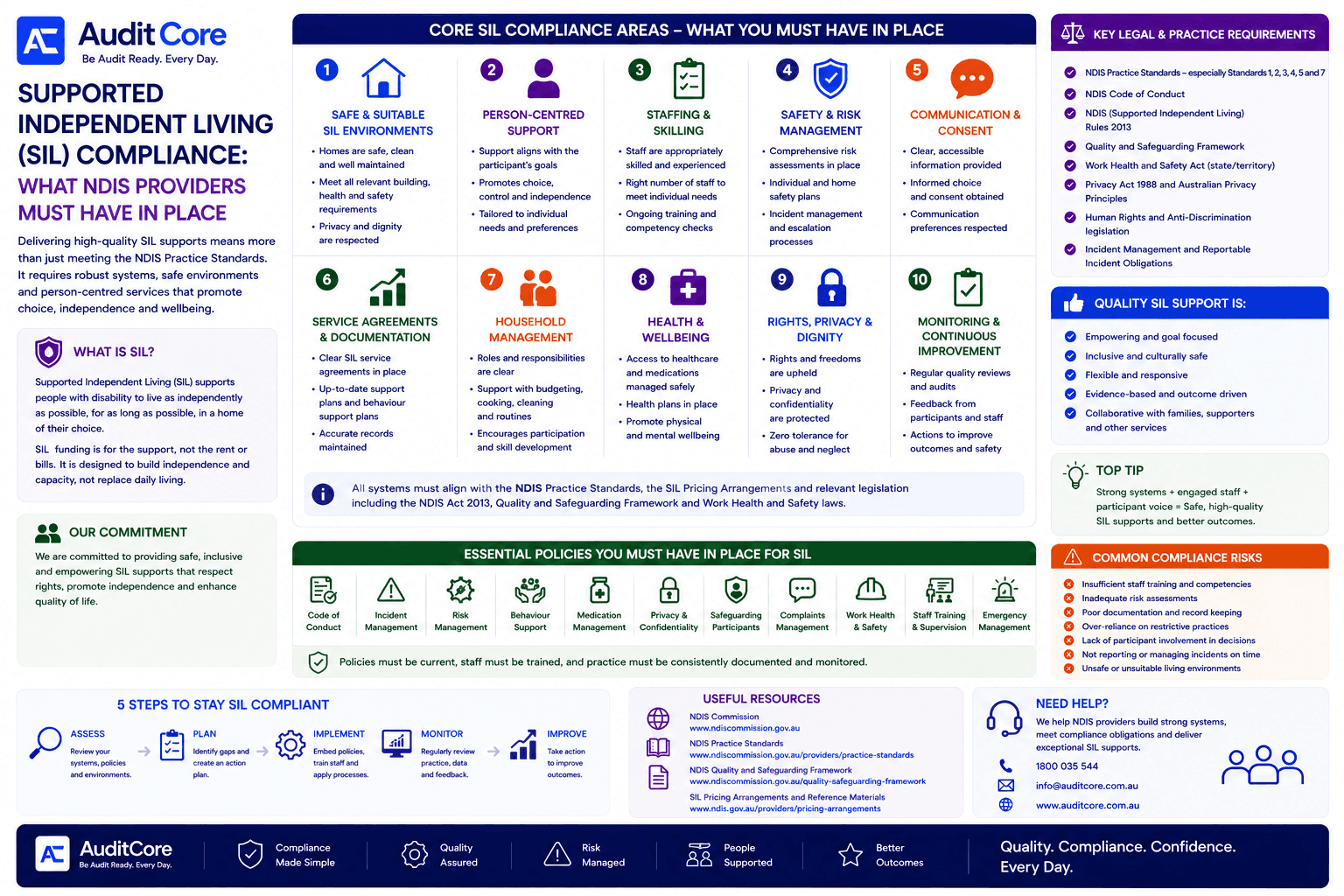
Supported Independent Living (SIL) refers to NDIS-funded supports that assist participants to live as independently as possible in their own home or shared living arrangements. SIL supports are typically funded as ongoing 24/7 or high-frequency support in shared accommodation. Because SIL providers are operating in participants' most private and intimate environments, the compliance obligations are among the most demanding in the NDIS framework.
What Is SIL?
Supported Independent Living (SIL) supports people with disability to live as independently as possible, for as long as possible, in a home of their choice. SIL funding is for the support — not the rent or bills. It is designed to build independence and capacity, not replace daily living. Delivering high-quality SIL supports means more than just meeting the NDIS Practice Standards. It requires robust systems, safe environments and person-centred services that promote choice, independence and wellbeing.
SIL Registration Requirements
To provide SIL supports, providers must be registered under registration group 0115 — Daily Activities. This requires the certification pathway — a full audit by a Commission-approved Quality Auditor. Providers must meet all four core Practice Standards plus may need supplementary modules depending on the support types delivered within the SIL setting (e.g., high intensity daily personal activities, behaviour support).
Practice Standards That Apply to SIL
All four core Practice Standards apply to SIL providers:
- Practice Standard 1 (Rights and Responsibilities): Participant rights in the home — privacy, choice, having visitors, making decisions about daily routines
- Practice Standard 2 (Governance and Operational Management): Risk management, incident reporting, complaints handling, continuous improvement
- Practice Standard 3 (Provision of Supports): Individual support planning, goal setting, regular reviews, transition planning
- Practice Standard 4 (Support Provision Environment): Safety in the home, emergency procedures, infection control, medication management
Key Legal & Practice Requirements
SIL providers must align their systems, policies and practice with all of the following:
- NDIS Practice Standards — especially Standards 1, 2, 3, 4, 5 and 7
- NDIS Code of Conduct — obligations for providers and workers
- NDIS (Supported Independent Living) Rules 2013 — specific SIL funding and service rules
- Quality and Safeguarding Framework — overarching framework for provider obligations
- Work Health and Safety Act (state/territory) — worker and participant safety in the home environment
- Privacy Act 1988 and Australian Privacy Principles — protection of participant personal information
- Human Rights and Anti-Discrimination legislation — upholding rights and dignity in all supports
- Incident Management and Reportable Incident Obligations — NDIS incident notification requirements
Core SIL Compliance Areas — What You Must Have in Place
Every SIL provider must have robust systems across all ten compliance areas. All systems must align with the NDIS Practice Standards, the SIL Pricing Arrangements and relevant legislation including the NDIS Act 2013, Quality and Safeguarding Framework and Work Health and Safety laws:
| Area | What's Required |
|---|---|
| 1. Safe & Suitable SIL Environments | Homes are safe, clean and well maintained; meet all relevant building, health and safety requirements; privacy and dignity are respected at all times |
| 2. Person-Centred Support | Support aligns with the participant's goals; promotes choice, control and independence; tailored to individual needs and preferences — not staff convenience |
| 3. Staffing & Skilling | Staff are appropriately skilled and experienced; right number of staff to meet individual needs; ongoing training and competency checks are in place |
| 4. Safety & Risk Management | Comprehensive risk assessments in place for each participant and the home environment; individual and home safety plans; incident management and escalation processes |
| 5. Communication & Consent | Clear, accessible information provided to participants; informed choice and consent obtained for all supports; communication preferences respected |
| 6. Service Agreements & Documentation | Clear SIL service agreements in place; up-to-date support plans and behaviour support plans; accurate and contemporaneous records maintained |
| 7. Household Management | Roles and responsibilities of workers are clear; support with budgeting, cooking, cleaning and routines; encourages participation and skill development |
| 8. Health & Wellbeing | Access to healthcare and medications managed safely; health plans in place for each participant; supports promote physical and mental wellbeing |
| 9. Rights, Privacy & Dignity | Rights and freedoms are upheld in the participant's home; privacy and confidentiality are protected; zero tolerance for abuse and neglect |
| 10. Monitoring & Continuous Improvement | Regular quality reviews and audits; feedback actively sought from participants and staff; actions taken to improve outcomes and safety |
Participant Rights in the Home
A SIL setting is a participant's home, not a facility. Auditors are particularly focused on whether SIL providers genuinely uphold participant rights within the home:
- Do participants have locks on their bedroom doors?
- Can participants have visitors without staff permission?
- Do participants have input into house rules, menus, and daily routines?
- Are house meetings facilitated in a way that genuinely reflects participant views?
- Are workers providing support in ways the participant chooses, not in ways that are convenient for the roster?
- Are participants' personal items treated with respect?
- Is there genuine privacy — workers knocking before entering rooms, not reading personal correspondence?
AuditCore's Participant Management module stores support plans, goal reviews, and daily notes for every SIL participant — with a clear audit trail showing that supports are delivered based on individual goals and preferences.
See Participant Management →SIL-Specific Documentation Requirements
Individual Support Plans
Every SIL participant must have a current individual support plan that documents their goals, the supports they receive, their preferences and routines, and how progress toward goals is measured. Plans must be reviewed at least annually or when circumstances change. Evidence of the participant's and their representative's involvement in the review is required.
Daily Progress Notes
Workers in SIL settings must maintain daily progress notes for each participant. Notes should be:
- Factual and objective
- Linked to the participant's goals and support plan
- Completed on the day (or at the end of the shift)
- Signed by the worker with their name and role
- Stored securely with appropriate access controls
Medication Records
Where workers administer medications, the following records are required:
- Medication chart signed by a medical practitioner
- Medication administration record — dose, time, worker signature for every administration
- Evidence of worker competency to administer specific medications
- Documentation of medication errors and the response taken
- Safe storage records
Safeguarding Documentation
SIL participants often have complex vulnerabilities. Auditors expect to see individual safeguarding plans that identify specific risks to each participant in their living environment and the strategies workers use to address them.
Incident Reporting in SIL Settings
Because SIL involves 24/7 contact, incident rates are typically higher than in other service types. Providers must ensure:
- Workers understand the difference between reportable and non-reportable incidents
- The incident reporting process is accessible at all hours — including after-hours shifts
- Incidents involving shared accommodation residents who are not NDIS participants are still assessed for reportability
- After-hours incidents are captured in the system the same day they occur
- Incident patterns are analysed — the same type of incident recurring is a systemic issue
AuditCore's Incident Management module is accessible from any device — workers on night shifts can log incidents immediately, and managers receive instant alerts for any reportable incident.
See Incident Management →SIL House Rules and Shared Living Agreements
Where multiple participants live together, providers should have documented house rules that reflect the collective wishes of residents. These should be:
- Developed with resident input — documented meeting records
- Reviewed at regular intervals and when there is a change in residents
- Non-restrictive in nature — rules should support cohabitation, not restrict individual rights
- Understood by all workers and residents
Essential Policies You Must Have in Place for SIL
Policies must be current, staff must be trained, and practice must be consistently documented and monitored. At minimum, every SIL provider requires:
- Code of Conduct — behaviour expectations for all workers in participants' homes
- Incident Management — identification, reporting, investigation, and corrective action
- Risk Management — comprehensive risk assessment and mitigation processes
- Behaviour Support — person-centred positive behaviour support approaches
- Medication Management — safe administration, storage, documentation, and error reporting
- Privacy & Confidentiality — protection of participant personal information in a home environment
- Safeguarding Participants — identification of and response to risks of abuse, neglect, and exploitation
- Complaints Management — accessible, fair, and timely complaints handling
- Work Health & Safety — safety obligations in home and shared living environments
- Staff Training & Supervision — mandatory competencies, ongoing training, and regular supervision
- Emergency Management — emergency procedures for each SIL property, including after-hours
5 Steps to Stay SIL Compliant
| Step | Action | What This Involves |
|---|---|---|
| 1. Assess | Review your systems, policies and environments | Audit your current documentation, staffing, safety systems, and participant rights practices against NDIS Practice Standards |
| 2. Plan | Identify gaps and create an action plan | Prioritise gaps by risk level and assign each action to a named person with a due date. Include in your continuous improvement register. |
| 3. Implement | Embed policies, train staff and apply processes | Roll out updated policies, deliver mandatory training, update records systems, and brief frontline staff on any changes |
| 4. Monitor | Regularly review practice, data and feedback | Analyse incident data, supervision records, audit findings, and participant feedback to check whether systems are working |
| 5. Improve | Take action to improve outcomes | Close the loop — implement learnings, update policies, and record improvements. Feed findings into the next annual review cycle. |
Quality SIL Support Is
- Empowering and goal focused — every support decision connects back to what the participant wants to achieve
- Inclusive and culturally safe — delivered in ways that respect each participant's identity, background, and communication needs
- Flexible and responsive — adapts to changes in the participant's goals, health, and circumstances without bureaucratic delay
- Evidence-based and outcome driven — progress is measured, documented, and reviewed against goals
- Collaborative with families, supporters and other services — SIL providers work as part of a broader support network, not in isolation
Common SIL Audit Failures
- Support plans not reviewed annually — or reviewed on paper but with no evidence of participant involvement
- Daily notes not completed — or completed as generic entries not linked to individual goals
- Restrictive practices in use without authorisation (this is extremely common in SIL settings)
- Workers administering medications without competency evidence
- After-hours incidents not reported — discovered only when a day shift manager reviews the shift notes
- Participant rights to home privacy not upheld in practice — workers entering rooms without knocking
- Safeguarding plans absent for high-risk participants
Common Compliance Risks
- Insufficient staff training and competencies — workers delivering high-intensity supports without documented competency verification
- Inadequate risk assessments — generic or incomplete assessments that don't reflect the individual participant's actual living environment
- Poor documentation and record keeping — progress notes, medication records, and incident reports missing or incomplete
- Over-reliance on restrictive practices — unauthorised restraint or seclusion used as a management strategy
- Lack of participant involvement in decisions — supports and house rules determined by staff without genuine participant input
- Not reporting or managing incidents on time — missed 24-hour or 5-day notification windows to the NDIS Commission
- Unsafe or unsuitable living environments — properties that don't meet health, safety, or accessibility standards
Strong systems + engaged staff + participant voice = safe, high-quality SIL supports and better outcomes.