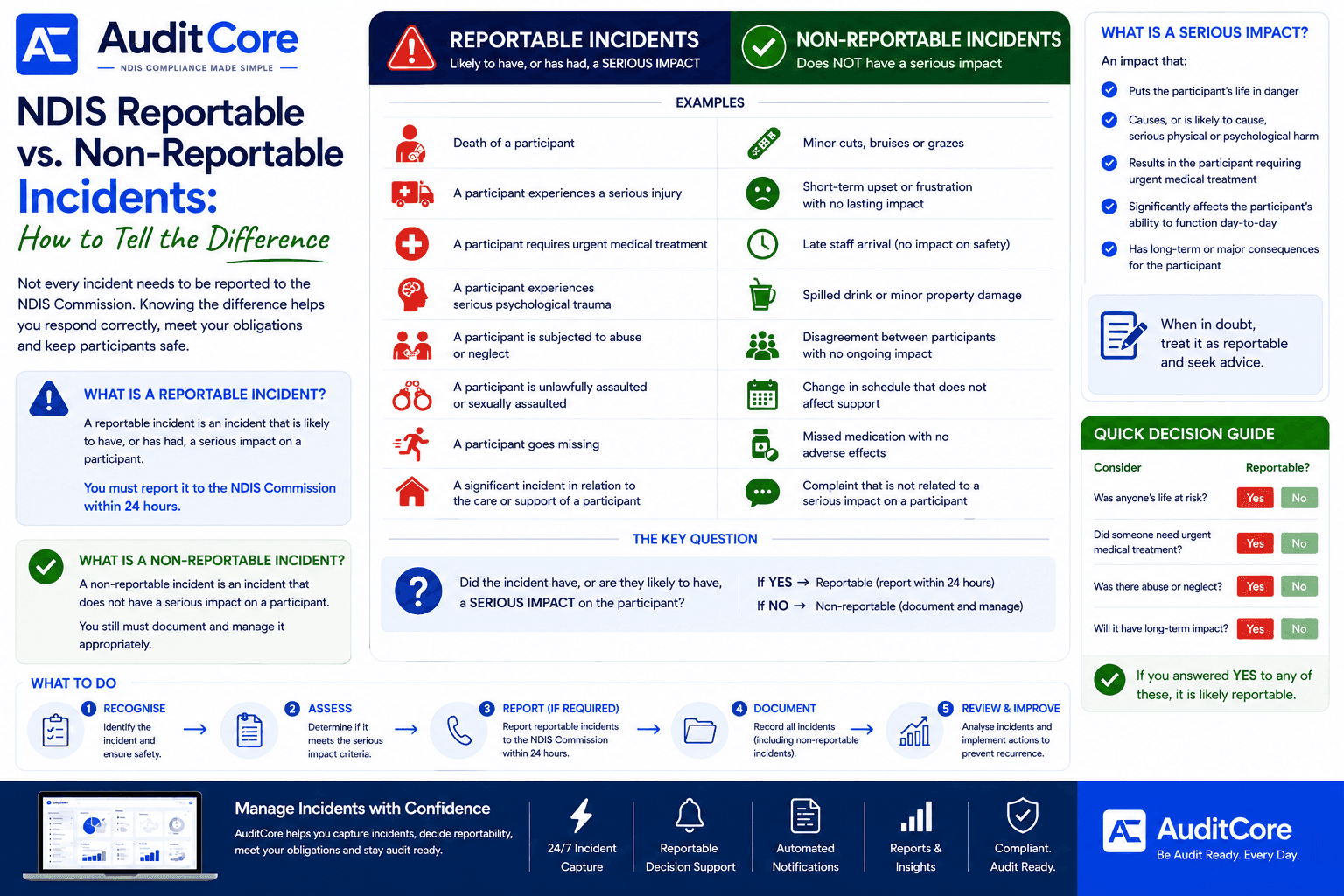
The difference between a reportable and non-reportable incident is not always obvious — and the consequences of getting it wrong are serious. Failing to report a reportable incident to the NDIS Commission is itself a compliance breach, and the Commission takes it seriously. AuditCore's incident classification AI is trained on the NDIS (Incident Management and Reportable Incidents) Rules 2018 and flags potentially reportable incidents at the point of entry.
The Core Definitions
| Type | Definition | What You Must Do |
|---|---|---|
| Reportable Incident | An incident that is likely to have, or has had, a serious impact on a participant | Report to the NDIS Commission within 24 hours (death) or 5 business days (all others) |
| Non-Reportable Incident | An incident that does not have a serious impact on a participant | Document internally and manage appropriately — still required |
What is a Serious Impact?
A serious impact is one that:
- Puts the participant's life in danger
- Causes, or is likely to cause, serious physical or psychological harm
- Results in the participant requiring urgent medical treatment
- Significantly affects the participant's ability to function day-to-day
- Has long-term or major consequences for the participant
Reportable vs. Non-Reportable: Examples Side by Side
| Reportable Incidents | Non-Reportable Incidents |
|---|---|
| Death of a participant | Minor cuts, bruises or grazes |
| A participant experiences a serious injury | Short-term upset or frustration with no lasting impact |
| A participant requires urgent medical treatment | Late staff arrival with no impact on safety |
| A participant experiences serious psychological trauma | Spilled drink or minor property damage |
| A participant is subjected to abuse or neglect | Disagreement between participants with no ongoing impact |
| A participant is unlawfully or sexually assaulted | Change in schedule that does not affect support |
| A participant goes missing | Missed medication with no adverse effects |
| A significant incident in relation to the care or support of a participant | Complaint not related to a serious impact on a participant |
The Key Question to Ask
Did the incident have, or is it likely to have, a SERIOUS IMPACT on the participant? If YES — it is reportable (report to the Commission within the required timeframe). If NO — it is non-reportable (document internally and manage). When in doubt, treat it as reportable and seek advice.
Quick Decision Guide
- Was anyone's life at risk? — If yes, reportable
- Did someone need urgent medical treatment? — If yes, reportable
- Was there abuse or neglect? — If yes, reportable
- Will it have long-term impact on the participant? — If yes, reportable
If you answered YES to any of these questions, it is likely reportable. Remember: it is better to report and be reviewed than not report and risk harm.
Reportable Incident Categories
AuditCore's Incident Management module automatically classifies incidents as reportable or non-reportable based on NDIS Commission definitions — and triggers the correct notification workflow for each type.
See Incident Management →| Category | Examples | Notification Timeframe |
|---|---|---|
| Death of a participant | Any participant death, including natural causes if they occur during the delivery of supports | 24 hours |
| Serious injury | Fractures, hospitalisation, injuries requiring medical treatment beyond first aid | 5 business days |
| Abuse or neglect | Physical, sexual, financial, psychological abuse or neglect by a worker or another participant | 5 business days |
| Unauthorised restrictive practice | Use of a regulated restrictive practice that has not been approved | 5 business days |
| Unexplained absence | Participant missing from services without explanation or authorisation | 5 business days |
| Behaviour of concern | Incidents involving behaviour that results in significant harm | 5 business days |
What to Do: 5-Step Process
- 1Recognise — identify the incident and ensure the immediate safety of the participant and others
- 2Assess — determine if it meets the serious impact criteria using the key question and quick decision guide above
- 3Report (if required) — report reportable incidents to the NDIS Commission within 24 hours (death) or 5 business days (all others)
- 4Document — record all incidents including non-reportable ones; thorough documentation is required for both categories
- 5Review and Improve — analyse incidents and implement actions to prevent recurrence
Non-Reportable Incidents — Document Internally
- Minor injuries requiring only basic first aid (small cuts, minor bruises)
- Participant emotional distress that was resolved within the session
- Worker-to-worker conflicts that do not involve participants
- Property damage with no participant harm
- Near-misses where no harm occurred and no participant was at risk
- Participant falls with no injury or only minor injury
The Grey Zone — When You Are Not Sure
If you are not sure whether an incident is reportable, the NDIS Commission's guidance is clear: if in doubt, report. A voluntary notification of a non-reportable incident is not a compliance failure. Failure to notify a reportable incident is. AuditCore's AI gives you a classification recommendation — you always have the final decision, but the prompt helps you catch incidents that might otherwise be misclassified.
The 5-Day vs. 24-Hour Rule
Most reportable incidents have a five-business-day notification window from the time the incident comes to the knowledge of the provider. For participant deaths, you have 24 hours. AuditCore starts the countdown from the moment the incident is logged and displays it prominently on your compliance dashboard.
Relevant NDIS Requirements
- NDIS Practice Standard S3 — Provision of Supports
- NDIS Practice Standard S4 — Support Provision Environment
- Incident Management and Reportable Incidents Scheme
- Duty of care and WHS obligations
How AuditCore Prevents Misclassification
When a worker logs an incident in AuditCore, the AI reads the description and compares it against the reportable incident categories. If it detects indicators of a potentially reportable incident — serious injury language, abuse keywords, restrictive practice references — it flags the incident for review by a compliance manager before the worker submits it as internal-only. This catches the misclassification before it becomes a compliance failure.