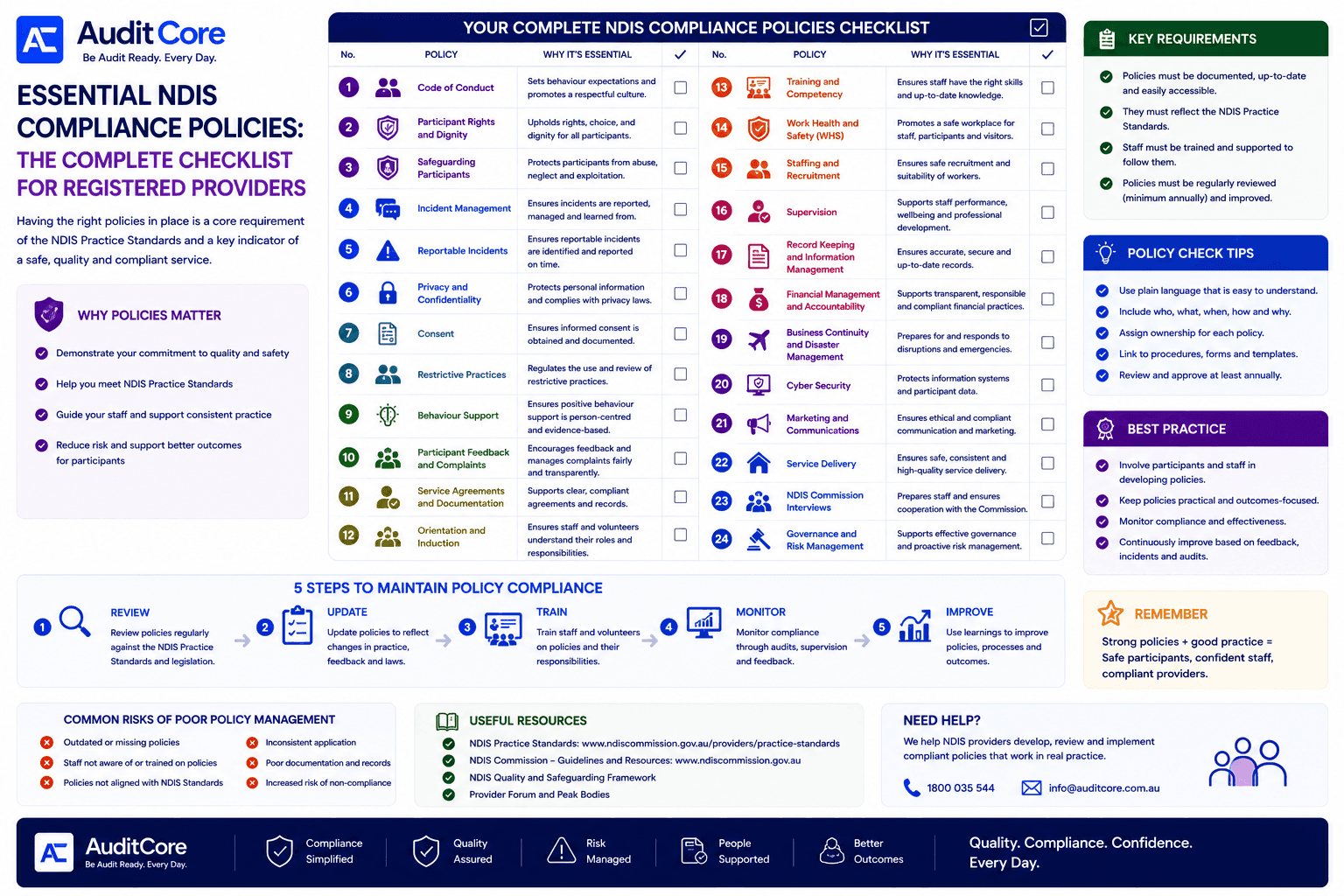
The NDIS Practice Standards do not prescribe an exact list of policies, but auditors assess whether your policies and procedures demonstrate how you meet each standard in practice. A policy that exists on paper but does not reflect what your workers actually do is a liability, not an asset. This checklist covers the policies auditors expect to see and what each must address.
Governance and Management Policies (Practice Standard 2)
- Risk Management Policy — how your organisation identifies, assesses, and manages operational and compliance risks
- Complaints and Feedback Policy — how participants and others can raise complaints, timeframes for response, escalation pathways, and how outcomes are communicated
- Incident Management Policy — definition of a reportable incident, notification responsibilities and timeframes, investigation process, and corrective action
- Continuous Improvement Policy — how your organisation uses data from audits, incidents, and complaints to improve
- Conflict of Interest Policy — how conflicts are identified, disclosed, and managed
- Privacy and Confidentiality Policy — how participant and worker information is collected, stored, accessed, and disposed of
- Financial Management Policy — financial controls, authorisation limits, fraud prevention
- Governance Policy — board roles and responsibilities, meeting requirements, oversight of management
AuditCore's Policy Library stores all your policies with version history, review dates, and staff acknowledgement records — ensuring every policy is current and every worker has confirmed they have read it.
See Policy Library →Rights and Responsibilities Policies (Practice Standard 1)
- NDIS Code of Conduct Policy — your organisation's obligations under the Code and how breaches are managed
- Participant Rights Policy — how you uphold participant rights including the right to make choices, access information, and raise concerns
- Dignity and Respect Policy — zero tolerance for abuse, neglect, and exploitation, with definitions and reporting obligations
- Informed Consent Policy — how consent is obtained, documented, and reviewed for all supports
- Advocacy and Decision-Making Support Policy — how you support participants to exercise decision-making and access advocacy
- Cultural Safety Policy — how services are delivered in a culturally safe and responsive way
Support Delivery Policies (Practice Standard 3)
- Service Agreement Policy — how service agreements are developed, explained, and reviewed with participants
- Support Planning Policy — how individual support plans are developed, implemented, monitored, and reviewed
- Person-Centred Practice Policy — how your organisation delivers supports based on individual goals and preferences
- Transition and Exit Policy — how supports transition between providers, how services are ended, and how handover documentation is managed
- Medication Management Policy (if applicable) — storage, administration, documentation, and error reporting for medications
Environment and Safety Policies (Practice Standard 4)
- Work Health and Safety Policy — obligations under WHS legislation, risk identification, incident reporting, and worker responsibilities
- Emergency Management Policy — emergency procedures for each service location, evacuation plans, and training requirements
- Infection Control Policy — standard precautions, PPE requirements, outbreak management
- Food Safety Policy (if applicable) — safe food handling for meal preparation supports
- Vehicle Safety Policy (if applicable) — driver requirements, vehicle maintenance, participant transport protocols
Worker Management Policies
- Recruitment and Selection Policy — NDIS Worker Screening Check requirements, reference checking, working with vulnerable people checks
- Induction Policy — what must be covered before a worker begins, documentation requirements, sign-off process
- Supervision and Performance Management Policy — supervision frequency, format, documentation, and performance review process
- Training and Professional Development Policy — mandatory training requirements, currency expectations, funding support
- Code of Conduct — specific to your organisation, reflecting the NDIS Code of Conduct and your organisational values
- Disciplinary and Dismissal Policy — how performance and conduct issues are managed, natural justice obligations
- Whistleblower Policy — how workers can raise concerns without fear of retaliation
Behaviour Support and Restrictive Practices Policies (if applicable)
- Behaviour Support Policy — approach to positive behaviour support, role of behaviour support practitioners, documentation requirements
- Restrictive Practices Policy — types of restrictive practices, authorisation requirements, reporting obligations, reduction goals
- Prohibited Practices Policy — explicit statement of practices that are never permitted regardless of circumstances
Policy Review Requirements
Having policies is not sufficient — they must be current. NDIS auditors check:
- When was the policy last reviewed? Policies not reviewed in the past 12 months are flagged.
- Does the policy reflect current legislation and NDIS Commission guidelines?
- Has the policy been reviewed in response to incidents, complaints, or regulatory changes?
- Are workers able to access policies — is the location documented and are workers aware of it?
- Is there evidence workers have read key policies — signed acknowledgements or training completion records?
Policy Review Schedule
Best practice is to review all policies annually as a minimum. High-risk policy areas — incident management, restrictive practices, behaviour support — should be reviewed after every significant incident in those areas, regardless of when the annual review is due. Build your policy review schedule into your continuous improvement calendar.