Under the NDIS (Restrictive Practices and Behaviour Support) Rules 2018, NDIS providers who support participants with behaviours of concern must have a behaviour support plan in place if any regulated restrictive practice is used. Even when no restrictive practices are involved, good practice — and increasingly, auditor expectation — requires documented positive behaviour support strategies for participants with complex needs.
What Is a Behaviour Support Plan?
A behaviour support plan is a positive, proactive and person-centred plan that supports a participant to improve quality of life and reduce behaviours of concern. It is developed using evidence-based methods and in collaboration with the participant and their support network. Behaviour support plans help participants live safely, achieve their goals and participate in the community. Providers must ensure plans are evidence-based, person-centred and documented in line with the NDIS Practice Standards and relevant legislation.
Principles of Positive Behaviour Support
- Person-centred — the plan is built around the individual's goals, preferences, strengths and life context
- Positive and proactive — the focus is on preventing behaviours of concern and building skills, not just reacting to incidents
- Evidence-based — strategies are grounded in functional assessment and behavioural science, not guesswork
- Collaborative — developed with the participant, their family, carers, and support team — not done to them
- Least restrictive — any restrictive practice is used only as a last resort after all alternatives have been tried and documented
Who Can Develop a Behaviour Support Plan?
Only NDIS-registered behaviour support practitioners can develop a behaviour support plan that authorises the use of a regulated restrictive practice. Practitioners must be registered with the NDIS Commission in the registration group 'Specialist Behaviour Support.' This is separate to a provider being registered to implement a behaviour support plan — that falls under the 'Implementing Behaviour Support Plans' registration group.
Providers who implement behaviour support plans developed by an external practitioner still have significant compliance obligations. You are responsible for ensuring your workers understand and follow the plan, that the plan is current, and that any restrictive practices are authorised and reported.
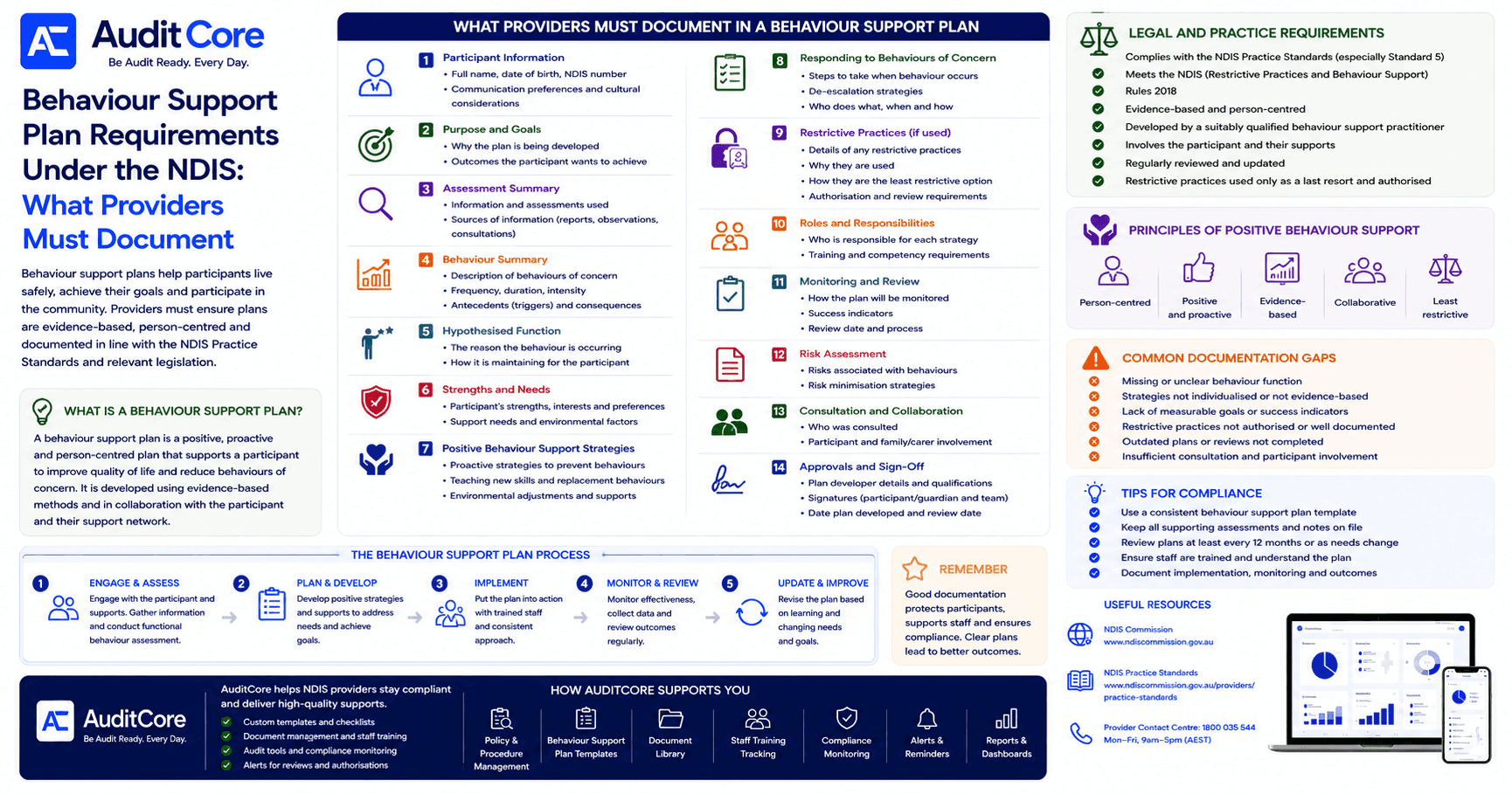
What Providers Must Document: The 14 Required Elements
| # | Required Element | What Must Be Documented |
|---|---|---|
| 1 | Participant Information | Full name, date of birth and NDIS participant number; communication preferences and cultural considerations |
| 2 | Purpose and Goals | Why the plan is being developed; the outcomes the participant wants to achieve |
| 3 | Assessment Summary | Information and assessments used to develop the plan; sources of information including reports, observations, and consultations |
| 4 | Behaviour Summary | Description of behaviours of concern; frequency, duration and intensity; antecedents (triggers) and consequences |
| 5 | Hypothesised Function | The reason the behaviour is occurring — what need it is meeting or communicating; how it is maintaining for the participant |
| 6 | Strengths and Needs | Participant's strengths, interests and preferences; support needs and environmental factors that affect behaviour |
| 7 | Positive Behaviour Support Strategies | Proactive strategies to prevent behaviours; teaching new skills and replacement behaviours; environmental adjustments and supports |
| 8 | Responding to Behaviours of Concern | Steps to take when behaviour occurs; de-escalation strategies; who does what, when and how |
| 9 | Restrictive Practices (if used) | Details of any restrictive practices; why they are used; how they are the least restrictive option; authorisation and review requirements |
| 10 | Roles and Responsibilities | Who is responsible for each strategy; training and competency requirements for workers implementing the plan |
| 11 | Monitoring and Review | How the plan will be monitored; success indicators; review date and review process |
| 12 | Risk Assessment | Risks associated with behaviours and support delivery; risk minimisation strategies |
| 13 | Consultation and Collaboration | Who was consulted in developing the plan; evidence of participant and family/carer involvement |
| 14 | Approvals and Sign-Off | Plan developer details and qualifications; signatures from participant/guardian and the support team; date plan developed and next review date |
What Must a Behaviour Support Plan Contain?
1. Functional Behaviour Assessment
The plan must be based on a functional behaviour assessment — a systematic process to understand the purpose (function) of the behaviour of concern. It identifies triggers, antecedents, the behaviour itself, and consequences. Without a sound functional assessment, the strategies in the plan have no evidence base.
2. Person-Centred Goals
Goals must reflect what the participant wants to achieve — improved communication, more community participation, reduced reliance on restrictive practices. The participant and their support network must be involved in developing these goals. Evidence of their involvement (e.g., meeting notes, signed consent) should be in the file.
3. Proactive Strategies
These are strategies to prevent behaviour of concern from occurring, and include:
- Environmental modifications (reducing sensory triggers, adjusting routines)
- Communication supports (AAC devices, visual schedules, social stories)
- Skill-building activities targeting the underlying function of the behaviour
- Engagement and activity planning to meet the participant's needs proactively
4. Reactive Strategies
These detail what workers should do when behaviour of concern occurs, including:
- De-escalation techniques specific to this participant
- The sequence of responses — what to try first, second, last
- Specific physical techniques if physical restraint is authorised (with exact method and limits)
- When to call for additional support or emergency services
- Post-incident support for the participant and staff
5. Restrictive Practice Details
If any regulated restrictive practice is included, the plan must specify:
- The type of restrictive practice
- The exact circumstances in which it may be used
- Who may implement it (role, training requirements)
- The duration limits
- The authorisation reference — including expiry date
- The reduction plan — measurable goals and timeline for elimination
6. Crisis Plan
A separate crisis protocol detailing what constitutes a crisis, who to call, and what immediate steps to take.
7. Review Schedule
Plans must be reviewed at least annually, or when there is a significant change in the participant's circumstances, after any serious incident, or when the participant or their representative requests a review.
AuditCore's Behaviour Support module stores each participant's current behaviour support plan with review reminders, tracks restrictive practice authorisation expiry, and links incident reports directly to the relevant plan.
See Behaviour Support →The Behaviour Support Plan Process
- 1Engage and Assess — Engage with the participant and their supports; gather information and conduct a functional behaviour assessment to understand the behaviour's purpose and triggers
- 2Plan and Develop — Develop positive strategies and supports to address needs and achieve goals; involve the participant, family and team in every decision
- 3Implement — Put the plan into action with trained staff using a consistent approach; all workers must understand their specific role and the strategies they are responsible for
- 4Monitor and Review — Monitor effectiveness, collect data and review outcomes regularly; success indicators and review dates must be established at the outset
- 5Update and Improve — Revise the plan based on learnings, outcomes, and changing needs and goals; never leave an ineffective plan in place without updating it
Legal and Practice Requirements
- Complies with the NDIS Practice Standards — especially Standard 5 (Specialist Behaviour Support and Implementing Behaviour Support Plans)
- Meets the NDIS (Restrictive Practices and Behaviour Support) Rules 2018 in every aspect
- Evidence-based and person-centred — strategies are grounded in functional assessment, not routine practice
- Developed by a suitably qualified and NDIS-registered behaviour support practitioner
- Involves the participant and their supports in development, review and all major decisions
- Regularly reviewed and updated — at least annually or when circumstances change significantly
- Restrictive practices used only as a last resort, properly authorised, and documented with a reduction plan
Provider Obligations When Implementing a Plan
When your organisation implements a behaviour support plan developed by an external practitioner, you must:
- Ensure every worker supporting that participant has read the plan and can demonstrate understanding — a signed acknowledgement per worker
- Provide training on any specific techniques required by the plan before workers implement them
- Document every instance of restrictive practice use (date, time, duration, reason, outcome)
- Submit monthly reports to the NDIS Commission on restrictive practice use
- Notify the Commission of any incidents related to restrictive practice use
- Contact the behaviour support practitioner immediately if the plan is not working or if circumstances change
- Ensure the plan is renewed before it expires — authorisations and plans have expiry dates
What Auditors Check
In a compliance audit or verification audit, auditors reviewing behaviour support will request:
- A list of all participants with behaviour support plans
- A copy of the current plan for each participant
- Evidence that each plan is developed by a registered behaviour support practitioner
- Worker training records — who has read and been trained on each plan
- Restrictive practice use records and Commission reporting records
- Evidence of participant involvement in plan development
- Incident records linked to behaviour support events
- Evidence the plan is current (within review period)
Common Documentation Gaps
- Missing or unclear behaviour function — strategies without a solid functional assessment have no evidence base and will be flagged
- Strategies not individualised or not evidence-based — generic strategies copied across multiple participants are a common finding
- Lack of measurable goals or success indicators — auditors cannot assess improvement without measurable targets
- Restrictive practices not authorised or well documented — expired authorisations or vague documentation are serious non-conformances
- Outdated plans or reviews not completed — a plan more than 12 months old without a documented review is non-compliant
- Insufficient consultation and participant involvement — no evidence the participant or family contributed to the plan
Tips for Compliance
- Use a consistent behaviour support plan template that prompts for all 14 required elements — gaps in the template become gaps in the plan
- Keep all supporting assessments and notes on file — the functional behaviour assessment is as important as the plan itself
- Review plans at least every 12 months or sooner when needs change — set calendar reminders so reviews happen proactively
- Ensure all staff are trained and understand the plan before implementing it — a signed training acknowledgement per worker is essential
- Document implementation, monitoring and outcomes consistently — evidence of the plan in action is what auditors need to see
Good documentation protects participants, supports staff and ensures compliance. Clear, evidence-based, person-centred plans lead to better outcomes — for the participant and for your organisation.
How AuditCore Supports Behaviour Support Plan Compliance
- Behaviour support plan templates — pre-built templates mapped to all 14 required documentation elements
- Document library — all plans, assessments, authorisations and reviews stored and version-controlled
- Staff training tracking — records of who has read and been trained on each participant's plan
- Compliance monitoring — real-time tracking of plan currency, authorisation expiry, and review dates
- Alerts and reminders — automated notifications for upcoming plan reviews, authorisation renewals, and reporting deadlines
- Reports and dashboards — compliance summary across your entire behaviour support caseload at a glance